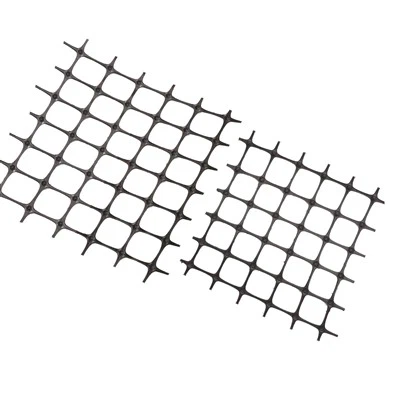

Bidirectional Geogrid (Biaxial Geogrid) for Soil Reinforcement & Load Distribution
High-performance PP/HDPE biaxial geogrid engineered for road base stabilization, subgrade reinforcement, railway foundation support, and large-scale infrastructure load distribution.
✔ High Tensile Strength in Both Directions
✔ Improves Subgrade Bearing Capacity
✔ Reduces Aggregate Thickness by up to 30%
What is Bidirectional Geogrid?
Bidirectional geogrid (also called biaxial geogrid) is a polymer-based reinforcement material designed with uniform tensile strength in both machine and cross-machine directions. It is widely used in soil stabilization systems to distribute loads evenly and reduce deformation in weak subgrades.
Compared with uniaxial geogrid, bidirectional geogrid provides balanced reinforcement performance, making it ideal for roads, parking areas, airport runways, and working platforms where multi-directional stress occurs.
Compared with uniaxial geogrid, bidirectional geogrid provides balanced reinforcement performance, making it ideal for roads, parking areas, airport runways, and working platforms where multi-directional stress occurs.
Engineering Applications
Road Construction
Reinforces subgrade, reduces rutting, and extends pavement service life.
Railway Subgrade
Improves ballast confinement and reduces settlement.
Parking Lots & Logistics Yards
Enhances load distribution under heavy static loads.
Airport Runways
Prevents differential settlement under repeated aircraft loading.
Why Engineering Buyers Choose Bidirectional Geogrid
In procurement decisions, engineers and contractors focus on long-term performance rather than material cost. Bidirectional geogrid delivers:
✔ Reduced aggregate consumption (cost saving up to 20–30%)
✔ Faster installation with improved construction efficiency
✔ Increased bearing capacity of weak soil foundations
✔ Improved long-term deformation resistance
✔ Compatible with sand, gravel, clay, and mixed soils
✔ Reduced aggregate consumption (cost saving up to 20–30%)
✔ Faster installation with improved construction efficiency
✔ Increased bearing capacity of weak soil foundations
✔ Improved long-term deformation resistance
✔ Compatible with sand, gravel, clay, and mixed soils
Technical Specifications (Typical Range)
| Item / Specification | WW15-15 | WW20-20 | WW25-25 | WW30-30 | WW35-35 | WW40-40 | WW45-45 | WW50-50 |
|---|---|---|---|---|---|---|---|---|
| Tensile Strength at Yield (Longitudinal) (kN/m) | 15 | 20 | 25 | 30 | 35 | 40 | 45 | 50 |
| Tensile Strength at Yield (Transverse) (kN/m) | 15 | 20 | 25 | 30 | 35 | 40 | 45 | 50 |
| Elongation at Yield (Longitudinal) (%) | ≤15 | |||||||
| Elongation at Yield (Transverse) (%) | ≤13 | |||||||
| Tensile Force at 2% Elongation (Longitudinal) (kN/m) | ≥5 | ≥7 | ≥9 | ≥10.5 | ≥12 | ≥14 | ≥16 | ≥17.5 |
| Tensile Force at 2% Elongation (Transverse) (kN/m) | ≥5 | ≥7 | ≥9 | ≥10.5 | ≥12 | ≥14 | ≥16 | ≥17.5 |
| Tensile Force at 5% Elongation (Longitudinal) (kN/m) | ≥7 | ≥14 | ≥17 | ≥21 | ≥24 | ≥28 | ≥32 | ≥35 |
| Tensile Force at 5% Elongation (Transverse) (kN/m) | ≥7 | ≥14 | ≥17 | ≥21 | ≥24 | ≥28 | ≥32 | ≥35 |
Tip: Special specifications will be produced according to contract or agreement requirements.
Bidirectional vs Uniaxial Geogrid
Bidirectional Geogrid
✔ Equal strength in two directions
✔ Ideal for road base & platform reinforcement
✔ Multi-directional load distribution
✔ Better for weak soil stabilization
✔ Ideal for road base & platform reinforcement
✔ Multi-directional load distribution
✔ Better for weak soil stabilization
Uniaxial Geogrid
✔ High strength in one direction only
✔ Best for retaining walls & slopes
✔ Directional reinforcement system
✔ Not suitable for uniform load areas
✔ Best for retaining walls & slopes
✔ Directional reinforcement system
✔ Not suitable for uniform load areas
What soil conditions require bidirectional geogrid?
It is recommended for soft soil, high moisture subgrade, and low bearing capacity foundations.
Can it reduce construction cost?
Yes. It reduces aggregate thickness and improves compaction efficiency, lowering overall project cost.
What is the service life?
Typically more than 20–50 years depending on soil conditions and UV exposure protection.
Get Engineering-Grade Bidirectional Geogrid Solution
Send your project requirements (soil type, load condition, thickness requirement) and our engineering team will provide a tailored reinforcement solution within 24 hours.
Hot Tags: bidirectional geogrid, China bidirectional geogrid manufacturers, suppliers, factory, biaxial geogrid, Biaxial Plastic Geogrid, geogrid construction, geogrid for erosion control, geogrids, woven geogrid