Professional Reinforcement polyester geogrid Manufacturer and Supplier in China
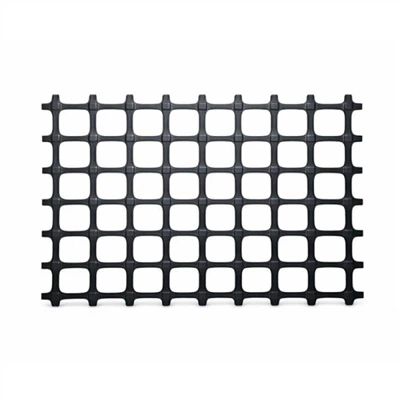
Polyester warp-knitted geogrid, also known as high-strength warp-knitted geogrid, is a geogrid made of high-strength fibers or polyester industrial filaments, woven into a mesh fabric.
Tensile strength: 25-25KN, 30-30KN, 50-50KN, 80-80KN, 100-100KN, 120-120KN, 150-150KN, 200-200KN
Roll size: As required
Polyester warp-knitted geogrid, also known as high-strength warp-knitted geogrid, is a geogrid made from high-strength fibers or polyester industrial filaments. It is oriented and warp-knitted into a mesh fabric, then coated with PVC. Also called polyester geogrid or warp-knitted geogrid, it uses a warp-knitting process to create an oriented structure where the warp and weft yarns are straight and interlocked. The intersections are bound together with high-strength fiber filaments to form strong joints, earning it the nickname "fiber-reinforced steel." It is a new type of high-quality geosynthetic material for reinforcing roadbeds. It is used in various high-grade highways and railways for soft roadbeds, embankments, slopes, and retaining walls to improve their bearing capacity and overall stability.
Product specifications and performance parameters
Standard technical parameters of warp-knitted polyester geogrid
Project / Specifications
PET20-20
PET30-30
PET40-40
PET50-50
PET80-80
PET100-100
PET120-120
PET140-140
PET180-180
PET200-200
PET300-300
PET400-400
PET500-500
PET600-600
Strength KN/m ≥ Longitudinal
20
30
40
50
80
100
120
140
180
200
300
400
500
600
Strength KN/m≥ Transverse
20
30
40
50
80
100
120
140
180
200
300
400
500
600
elongation %
13
Grid center distance mm
12.7x12.7 25.4x25.4 40x40
Width m
1-6
Remark
Specific specifications can be customized according to customer needs.
Technical parameters of warp-knitted polyester geogrid (irregular shape)
Project / Specifications
PET50-30
PET60-35
PET80-30
PET80-50
PET100-50
PET100-85
PET120-50
PET140-60
PET160-80
PET180-100
PET200-100
PET300-200
PET400-300
PET600-400
Strength KN/m ≥ Longitudinal
50
60
80
80
100
100
120
140
160
180
200
300
400
600
Strength KN/m≥ Transverse
30
35
30
50
50
85
50
60
80
100
100
200
300
400
elongation %
13
Grid center distance mm
12.7x12.7 25.4x25.4 40x40
Width m
1-6
Remark
Specific specifications can be customized according to customer needs.
Construction Method
The geogrid should be laid on the coarse aggregate of the asphalt layer of the construction road surface. The existing road surface should be leveled first, and then constructed after being sorted, repaired and cleaned. Ordinary geogrids need to be fixed with specific steel nails. The overlap of the geogrids should be greater than 5cm in the transverse direction and greater than 10cm in the longitudinal direction. When laying asphalt-treated geogrids, minimize the amount of asphalt tack coat. Use self-adhesive geogrids for construction. After moderate compaction with a rubber-tired roller, the asphalt mixture can be laid and compacted. No specific steel nails are required for fixing.
We are a professional polyester geogrid manufacturer dedicated to delivering high-performance soil reinforcement solutions for global infrastructure projects. Equipped with advanced production lines and strict quality control systems, our factory ensures consistent tensile strength, durability, and long service life. Our products are widely used in road construction, retaining walls, embankments, and soft soil stabilization. With strong customization capabilities, fast delivery, and reliable technical support, we help contractors and distributors reduce project costs while improving structural stability. Partner with us for dependable geosynthetic solutions that meet international standards.
Land Reclamation Construction Process
Before laying, divers probe the medium-coarse sand cushion layer, removing foreign objects and protrusions;
The laying vessel is positioned using GPS measurements via horizontal control coordinates. The vessel is then anchored and its cable is moved; the geogrid is laid longitudinally perpendicular to the breakwater axis;
One end of the geogrid is secured to the medium-coarse sand foundation surface with sandbags. The laying vessel then unfolds the geogrid along the outline of the medium-coarse sand foundation and tightens it underwater;
A 300mm thick layer of riprap is placed on top of the geogrid. After each section of geogrid is laid, the riprap and the supporting stones on both sides are backfilled promptly; the supporting stones and riprap are laid using a self-propelled barge equipped with an excavator. The barge is loaded at the loading point and then sails to the designated section, positioned with a figure-eight cable, and the excavator performs underwater backfilling. A cross section is set up every 2m. A measuring rope is pulled from the slope shoulder and a measuring point is set up every 1m. The filling elevation is measured with a sounding weight while the stones are being thrown. The filling elevation and thickness are strictly controlled.
Reinforcement Polyester Geogrid Solutions
Looking for high-strength polyester geogrid for soil reinforcement? We provide durable, cost-effective solutions for roads, embankments, and retaining walls. OEM supported, fast delivery, and global project experience.