Geotextile vs Geomembrane: Functions and Applications
In geotechnical systems, geotextiles and geomembranes are applied in the same projects but perform different engineering functions. Their behavior is determined by permeability, polymer structure, and interaction with soil and hydraulic pressure.
Engineering Context of Material Selection
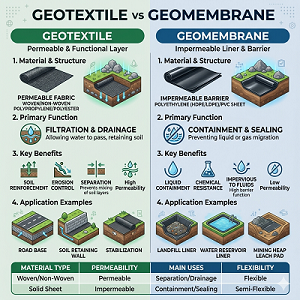
In field engineering, material selection is defined by whether the system must control water movement or stop it completely. Geotextiles are installed to manage filtration and stress distribution within soil layers. Geomembranes are installed to create a continuous barrier that isolates liquid systems from the surrounding environment.
Both materials are often combined in landfill bases, reservoirs, and mining structures where filtration, separation, and sealing functions must operate simultaneously under hydraulic loading and soil deformation.
Hydraulic Behavior and Structural Mechanism
Geotextile Flow Control Mechanism
Water passes through the fiber network while soil particles are retained based on pore size distribution. This mechanism allows the material to maintain hydraulic conductivity while preventing soil migration.
The structure distributes tensile forces across fibers, reducing localized stress concentration in soft subgrades.
Geomembrane Barrier Mechanism
The polymer sheet eliminates interconnected voids, so fluid movement occurs only through diffusion at a molecular level. This structure prevents seepage under hydrostatic pressure conditions.
The material maintains integrity under long-term chemical exposure in landfill leachate and mining solutions.
Material Structure and Manufacturing Process
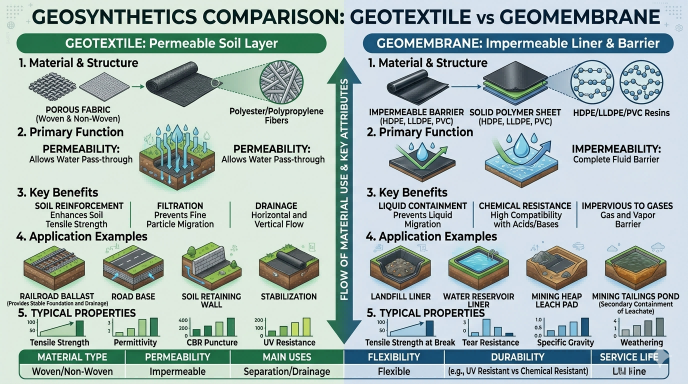
Geotextiles are manufactured using polypropylene or polyester fibers arranged through needle punching or weaving processes. The resulting structure creates interconnected voids that allow controlled water flow while stabilizing soil particles.
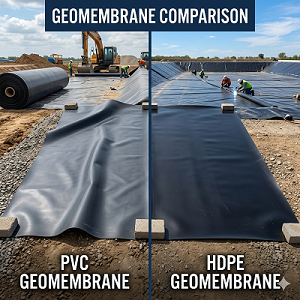
Geomembranes are produced through extrusion of HDPE or related polymers. The molten polymer is formed into a continuous sheet and cooled to create a dense structure that blocks hydraulic transmission and chemical penetration.
Engineering Performance in Field Conditions
Geotextiles function under mechanical loading by separating soil layers and distributing stress caused by traffic, settlement, and hydraulic flow. They also maintain drainage pathways to prevent pore water pressure accumulation.
Geomembranes function under hydraulic pressure by sealing containment systems and preventing leakage through soil or structural interfaces. Their performance is dependent on seam welding quality and installation control.
Interface interaction is critical in slope applications. Geotextiles increase friction stability, while geomembranes require protective layers to prevent sliding and puncture under load.
Engineering Application Systems
Geotextile Field Functions
In road construction, geotextiles separate subgrade soil from aggregate layers and distribute traffic load to reduce deformation. In drainage systems, they filter fine particles while maintaining water flow toward drainage outlets.
In river protection, they reduce erosion by dispersing hydraulic energy along soil interfaces.
Geomembrane Field Functions
In landfill systems, geomembranes isolate waste from groundwater by forming a continuous impermeable barrier. In reservoirs, they prevent seepage loss through soil foundations.
In mining systems, they contain chemical solutions and prevent contamination of surrounding soil layers.
Composite Lining System Interaction
In engineering design, geotextile and geomembrane systems are often combined. The geotextile layer protects the geomembrane from puncture caused by subgrade irregularities and distributes load. The geomembrane layer provides hydraulic isolation and prevents fluid migration.
This combination is commonly applied in landfill base liners, reservoir waterproofing systems, and mining heap leach pads where both filtration and sealing functions are required.
Engineering Summary
Geotextiles operate as filtration and reinforcement layers that control soil behavior and water movement. Geomembranes operate as containment layers that isolate hydraulic systems and prevent leakage.
The selection of each material is determined by hydraulic design requirements, soil conditions, and expected service environment.


Request Engineering Material Selection Support
Contact our engineering team for project-specific material design, technical parameters, and geosynthetic system recommendations.