Application of Geosynthetic Materials in Battery Energy Storage System (BESS) Projects: A Full-Scenario Engineering Study
Abstract
With the rapid deployment of utility-scale Battery Energy Storage Systems (BESS), civil and geotechnical engineering challenges have become increasingly prominent. Key issues such as soft soil settlement, electrolyte leakage contamination, stormwater and firewater containment, slope erosion, and uneven foundation deformation pose significant risks to the long-term safety and stability of energy storage facilities.
Geosynthetic materials-including geotextiles, HDPE geomembranes, geogrids, geosynthetic clay liners (GCL), 3D drainage geonets, and geocells-have emerged as essential engineering solutions in BESS infrastructure. These materials provide integrated functions of reinforcement, impermeable containment, drainage control, erosion protection, and environmental isolation.
This paper systematically analyzes the full-scenario application of geosynthetics in BESS projects, covering foundation treatment, battery container platforms, emergency containment ponds, drainage systems, slope protection, and cable trench waterproofing. It also discusses material selection principles, installation methodologies, construction quality control, and compares geosynthetic systems with conventional concrete-based approaches in terms of cost, efficiency, and environmental performance.
Keywords: BESS, geosynthetics, HDPE geomembrane, geogrid reinforcement, electrolyte containment, drainage systems, environmental protection
1. Introduction
Driven by global decarbonization policies and the rapid expansion of renewable energy integration, lithium-ion containerized BESS facilities are being deployed at unprecedented scale. Unlike conventional industrial plants, BESS projects present unique engineering risks:
Concentrated heavy loads from battery containers and power equipment
Potential electrolyte leakage during thermal runaway events
Large volumes of fire suppression wastewater containing hazardous lithium compounds
Complex site conditions, often located on soft soil, reclaimed land, river terraces, or low-bearing subgrades
These conditions significantly increase the risk of differential settlement, structural misalignment, electrical system failure, and environmental contamination.
Traditional solutions such as reinforced concrete containment structures and masonry slope protection are increasingly inadequate due to high cost, long construction cycles, and poor adaptability to deformation and cracking under uneven settlement conditions.
In contrast, geosynthetic materials offer high chemical resistance, flexibility, rapid installation, and cost efficiency, making them a preferred solution in modern BESS civil engineering design. Standardized geosynthetic containment systems are already widely adopted in utility-scale energy storage projects across Europe and North America.
2. Classification and Functional Roles of Geosynthetics in BESS Projects
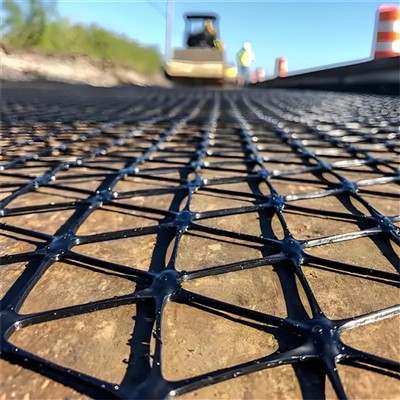
2.1 Geogrids for Subgrade Reinforcement and Platform Stabilization
Application Areas:
Battery container foundations
Internal access roads
Heavy-load maintenance corridors
Geogrids (biaxial, uniaxial, and steel-plastic composite types) are used to reinforce soft soil subgrades by interlocking with granular fill materials. This mechanism significantly improves load distribution and reduces differential settlement.
A typical reinforced structure consists of:
Compacted subgrade soil
Crushed stone or sand base layer
Biaxial geogrid reinforcement layer
Engineering benefits include:
Increased bearing capacity
Reduced settlement deformation
Lower aggregate consumption (up to 30% reduction)
Faster construction cycles (up to 40% time savings compared to full replacement methods)
For example, in the UK Uskmouth 100MW BESS project, PET high-strength geogrid reinforcement was applied to an 8,000 m² equipment platform, achieving settlement control within 15 mm after five years of operation.
2.2 HDPE Geomembrane + Geotextile Composite System for Containment Protection
Secondary containment systems are mandatory safety components in large-scale BESS facilities to manage potential electrolyte leakage and firewater runoff.
A typical anti-seepage structure includes:
- Protective geotextile (upper layer)
- 1.5–2.0 mm HDPE geomembrane (impermeable barrier)
- Protective geotextile (lower layer)
This composite system ensures both mechanical protection and hydraulic isolation.
HDPE geomembranes provide:
- Extremely low permeability (≤ 1×10⁻¹³ cm/s)
- High resistance to acidic electrolyte solutions
- Long service life and UV stability
- Excellent puncture resistance when combined with geotextile cushioning
In addition, GCL (Geosynthetic Clay Liners) can be applied in smaller distributed energy storage systems or auxiliary containment trenches.
Drainage geonets are often installed beneath geomembranes to relieve pore water pressure and prevent uplift failure, ensuring structural stability of the containment system.
2.3 Drainage Systems Using Geonets and Geotextiles
Effective stormwater and subsurface drainage design is critical for maintaining operational safety in BESS facilities.
Key drainage applications include:
Surface runoff management
Subsurface drainage layers beneath equipment pads
Cable trench dewatering systems
Perimeter drainage channels
A typical system uses:
Nonwoven geotextile filtration layer
3D composite drainage geonet core
This configuration enables rapid water collection and horizontal transport while preventing soil particle clogging.
Benefits include:
Reduced hydrostatic pressure
Improved foundation durability
Protection of electrical infrastructure from water exposure
Lower long-term maintenance requirements
2.4 Geocells and Erosion Control Systems for Slope Protection
BESS sites often require slope cutting and land shaping, particularly in hilly or reclaimed areas.
Geocell systems filled with soil or aggregate provide:
Lateral confinement of fill materials
Improved slope stability
Resistance to erosion and rainfall runoff
Support for vegetation growth in eco-friendly slope designs
Combined with erosion control mats, geocell systems replace traditional masonry slope protection, reducing environmental impact and long-term maintenance costs.
3. Typical Anti-Seepage Structure in BESS Containment Systems
A standard geosynthetic containment structure for battery energy storage facilities typically follows this layered configuration (top to bottom):
Protective nonwoven geotextile (200 g/m²)
HDPE geomembrane (1.5 mm, double-seam welded)
Cushion geotextile (300 g/m²)
Composite drainage geonet layer
Construction requirements include:
Overlap width ≥ 150 mm
Welding temperature: 220–280°C
Electrical spark testing of seams
Reinforcement at corners and stress concentration zones
Fully sealed anchoring trenches
This system ensures complete hydraulic isolation and long-term containment reliability.
4. Cost, Safety, and Performance Advantages
Compared with conventional reinforced concrete containment systems, geosynthetic solutions provide significant engineering and economic advantages:
Cost Efficiency
30–45% lower construction cost
Over 25% reduction in earthwork and material consumption
Safety Performance
Resistant to chemical attack from lithium electrolyte compounds
Accommodates differential settlement without cracking
Eliminates leakage risks associated with concrete joint failure
Construction Speed
Installation speed is 2–3 times faster than concrete systems
Suitable for fast-track grid connection schedules
Lifecycle Performance
Design service life exceeding 30 years
Minimal maintenance requirements
High adaptability to climate and soil conditions
5. Future Development Trends in Geosynthetics for Energy Storage
As BESS projects evolve toward larger capacities and stricter environmental compliance standards, geosynthetic materials are expected to advance in the following directions:
Acid-Resistant Geomembranes
Enhanced formulations with improved resistance to electrolyte corrosion and low-temperature brittleness for extreme climate regions.
Flame-Retardant Geotextiles
Designed for installation near battery containers to improve fire safety performance under thermal runaway conditions.
Factory-Pre-Fabricated Composite Liners
Integration of geotextiles and geomembranes into prefabricated rolls to reduce on-site installation errors and improve quality consistency.
6. Conclusion
Geosynthetic materials have become indispensable components in modern Battery Energy Storage System infrastructure. Their applications span foundation reinforcement, containment systems, drainage control, and environmental protection, forming a comprehensive civil engineering solution for energy storage projects.
As environmental regulations become more stringent and project scales continue to expand, geosynthetic-based engineering systems are expected to become standard practice in BESS design.
By combining geotechnical performance with environmental safety and construction efficiency, geosynthetics provide a critical foundation for the sustainable development of global energy storage infrastructure.