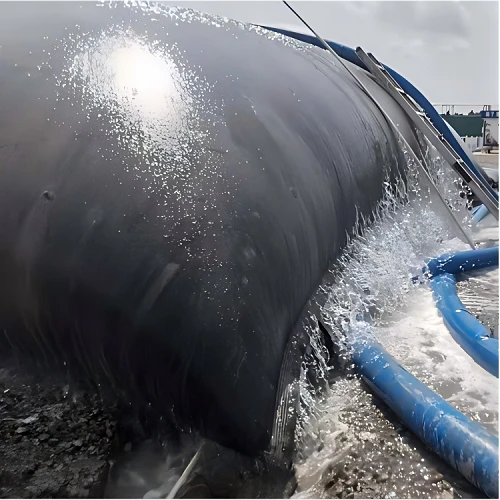
Large-scale aquaculture projects require more than simply placing a geomembrane over the pond bottom. Pond size, water depth, soil conditions, groundwater, slope stability, wind-induced waves, liner protection, anchoring and field welding can all affect the long-term performance of an HDPE geomembrane system.
For large earthen fish ponds, especially ponds covering tens of thousands of square meters, project owners and contractors often need to decide between 0.75 mm and 1.0 mm HDPE smooth geomembrane, while also considering whether a non-woven geotextile protection layer is necessary.
This article explains the key factors that should be evaluated when designing an HDPE geomembrane liner system for large fish ponds.
1. Why Use HDPE Geomembrane in Fish Ponds?
Traditional earthen fish ponds can lose significant amounts of water through soil infiltration. This can increase water consumption, complicate water-level management and make it more difficult to maintain consistent aquaculture conditions.
An HDPE geomembrane liner creates a low-permeability barrier between the pond water and the underlying soil.
A properly designed liner system can help:
- Reduce water leakage and seepage
- Improve water-level control
- Reduce water losses
- Separate pond water from potentially problematic soil
- Simplify pond maintenance
- Improve control of water quality conditions
- Provide a consistent impermeable lining system
- Support large-scale aquaculture pond construction
For commercial aquaculture projects, however, the geomembrane itself is only one part of the overall system.
The subgrade, geotextile protection layer, liner layout, anchoring and welding quality are equally important.
2. Large Fish Ponds Require a Different Approach
The requirements of a 1,000–5,000 m² pond are very different from those of a pond covering 50,000 m² or more.
As pond size increases, several engineering considerations become increasingly important.
Larger liner area
A large pond may require hundreds of thousands of square meters of geomembrane across multiple ponds.
This means that:
- Roll planning becomes important
- Panel layout becomes important
- Weld seam length increases
- Construction time increases
- Quality control becomes more demanding
- Material consistency becomes critical
For example, a project consisting of eight ponds, each approximately 50,000 m², would have a net pond area of approximately 400,000 m² before allowing for overlaps, slopes and anchoring areas.
The actual geomembrane procurement quantity could therefore be significantly higher.
3. 0.75 mm vs. 1.0 mm HDPE Geomembrane
One of the most common questions in fish pond projects is:
Should we use 0.75 mm or 1.0 mm HDPE geomembrane?
There is no universal answer based on pond area alone.
A proper thickness recommendation should consider the entire installation environment.
| Factor | 0.75 mm HDPE | 1.0 mm HDPE |
|---|---|---|
| Material thickness | Lower | Higher |
| Material handling | Relatively easier | More robust |
| Resistance to installation damage | Lower | Higher |
| Puncture resistance | Lower | Higher |
| Large-project handling | Suitable with proper subgrade | More robust |
| Cost per m² | Generally lower | Generally higher |
| Suitable application | Controlled subgrade and moderate conditions | More demanding projects |
| Long-term project margin | Depends on design | Generally provides greater material robustness |
The important point is that 1.0 mm should not automatically be selected simply because the pond is large.
Similarly, 0.75 mm should not be selected solely because it is less expensive.
The final specification should be based on the project's actual engineering conditions.
4. Pond Water Depth Is More Important Than Pond Area Alone
A 50,000 m² pond does not necessarily require the same geomembrane specification as another 50,000 m² pond.
Why?
Because the water depth and pond geometry can be very different.
The engineering team should evaluate:
- Maximum water depth
- Average water depth
- Pond side slopes
- Pond bottom configuration
- Water-level fluctuations
- Local loading conditions
- Subgrade conditions
The hydrostatic pressure generated by pond water increases with water depth.
Therefore, when evaluating geomembrane selection, the question should not simply be:
"How large is the pond?"
It should be:
"How large is the pond, how deep is it, what is the slope, and what conditions exist beneath the liner?"
5. Soil Conditions Can Determine the Need for Geotextile Protection
Geomembrane should not simply be installed over an untreated soil surface.
Before liner installation, the subgrade should generally be evaluated for:
- Stones
- Sharp objects
- Roots
- Construction debris
- Uneven surfaces
- Soft spots
- Differential settlement
- Excessive groundwater pressure
Even a high-quality HDPE geomembrane can be damaged during installation if the underlying surface contains sharp objects or irregularities.
This is where non-woven geotextile can play an important role.
6. Why Use Non-Woven Geotextile Under HDPE Geomembrane?
A non-woven geotextile can be used as a protective cushion layer between the prepared soil and geomembrane.
Its purpose is not to replace the geomembrane's waterproofing function.
Instead, it can help:
- Protect the liner from puncture
- Reduce localized stress
- Provide cushioning against irregularities
- Improve separation between soil and liner
- Support safer liner installation
For many fish pond applications, project designers may consider a 200 gsm non-woven geotextile as one possible protection layer.
However, the appropriate geotextile weight should be determined according to actual subgrade conditions and project requirements.
7. High Groundwater Levels Need Special Attention
Groundwater is another factor that should not be overlooked.
If the groundwater level beneath the pond is relatively high, the project should consider the pressure acting from underneath the liner, especially when the pond is empty or partially drained.
This creates a different engineering issue from normal water leakage.
The design team may need to evaluate:
- Groundwater level
- Pond bottom elevation
- Subsurface drainage
- Hydrostatic pressure
- Liner uplift
- Drainage provisions
- Subgrade stability
Therefore, for projects in areas with high groundwater levels, geomembrane selection should be part of a broader pond liner and drainage design, rather than treated as an isolated material purchase.
8. Wind and Waves Can Affect Large Pond Liners
Large open fish ponds can experience wind-induced waves.
Wave action may affect:
- Water-level fluctuations
- Pond edges
- Liner movement
- Anchor zones
- Exposed geomembrane
- Pond slope areas
The liner should therefore be properly positioned and secured.
An anchoring trench around the pond perimeter is commonly considered to secure the geomembrane and accommodate liner movement.
The final anchoring design should be based on:
- Pond geometry
- Side slope
- Soil characteristics
- Wind conditions
- Water depth
- Liner layout
9. Geomembrane Welding Is Critical for Large Fish Ponds
For a large geomembrane project, the quality of the field seams can be just as important as the quality of the geomembrane itself.
Even if the membrane has excellent impermeability, poorly welded seams can create leakage points.
For HDPE geomembrane installation, automatic hot-wedge welding machines are commonly used for long straight seams.
For more complicated details, corners or penetrations, an extrusion welder may also be required.
A typical installation process includes:
Step 1 - Subgrade preparation
Remove sharp objects and prepare a smooth, stable surface.
Step 2 - Geotextile installation
Where required, install the specified protective geotextile layer.
Step 3 - Geomembrane deployment
Roll out and position the geomembrane according to the approved panel layout.
Step 4 - Temporary positioning
Prevent excessive movement caused by wind or construction activities.
Step 5 - Trial welding
Conduct trial welds before production welding.
Step 6 - Automatic hot-wedge welding
Weld the main geomembrane seams using appropriate machine settings.
Step 7 - Seam inspection
Inspect the welded seams visually and through appropriate nondestructive testing methods.
Step 8 - Repair and retest
Any defective areas should be repaired and retested before the liner is accepted.
10. Welding Parameters Should Not Be Chosen by Thickness Alone
A common mistake is to assume that a specific welding temperature or speed is universally suitable.
In practice, welding conditions can be affected by:
- Geomembrane thickness
- Ambient temperature
- Weather conditions
- Machine type
- Machine pressure
- Welding speed
- Heating temperature
- Material formulation
Therefore, the installation team should perform trial welding before large-scale production welding begins.
The actual welding parameters should be established based on the membrane manufacturer's recommendations and field trial results.
11. Roll Width and Panel Layout Matter for a 400,000+ m² Project
For very large projects, procurement should not focus only on:
price per square meter
The roll dimensions can significantly affect installation efficiency.
Before production, the supplier and contractor should discuss:
- Roll width
- Roll length
- Roll weight
- Transportation limitations
- Unloading equipment
- Panel layout
- Seam orientation
- Number of seams
- Installation sequence
A good panel layout can reduce unnecessary seams and material waste.
This becomes increasingly important when the total project quantity reaches hundreds of thousands of square meters.
12. Large Projects Should Consider Phased Delivery
For a project involving hundreds of thousands of square meters of geomembrane, shipping everything in one batch may not always be the most practical approach.
A phased delivery plan can coordinate:
Production → Shipping → Site Receiving → Installation → Next Shipment
For example, the supplier and contractor can establish:
- First shipment
- Second shipment
- Third shipment
- Subsequent shipments
- according to the actual construction schedule.
- This approach can help reduce:
- On-site storage pressure
- Material handling problems
- Working-capital pressure
Risk of unnecessary long-term outdoor storage
13. What Should Buyers Request From a Geomembrane Supplier?
For a large aquaculture project, buyers should request more than a simple price list.
A professional RFQ should include:
Product information
HDPE geomembrane type
- Thickness
- Surface type
- Roll dimensions
- Raw material information
Technical documentation
Technical Data Sheet
Product specifications
Relevant test reports
Quality control information
Applicable standards
Commercial information
FOB price
CFR/CIF price where applicable
Minimum order quantity
Production lead time
Packing details
Loading quantity
Installation support
Welding recommendations
Hot-wedge welding guidance
Trial welding recommendations
Seam testing guidance
Installation instructions
Project experience
Ask the supplier for relevant references involving:
Fish ponds
Aquaculture
Reservoirs
Irrigation ponds
Large-scale water containment projects
The more similar the reference project, the more useful it is for technical evaluation.
14. How Should a Large Fish Pond Project Evaluate 0.75 mm vs. 1.0 mm?
A practical evaluation can follow this sequence:
Step 1
Determine the pond dimensions and maximum water depth.
Step 2
Evaluate the soil and subgrade conditions.
Step 3
Determine whether a geotextile protection layer is required.
Step 4
Evaluate groundwater conditions.
Step 5
Review pond slopes and anchoring requirements.
Step 6
Compare 0.75 mm and 1.0 mm geomembrane based on project-specific mechanical and installation requirements.
Step 7
Review welding and installation capabilities.
Step 8
Calculate the complete project cost, rather than comparing only membrane unit prices.
This is important because the lowest membrane price does not necessarily result in the lowest overall project cost.
15. Sample Testing Before Mass Production
For a large project, requesting samples before confirming the full order is a sensible quality-control step.
A buyer may request:
0.75 mm HDPE geomembrane sample
1.0 mm HDPE geomembrane sample
200 gsm non-woven geotextile sample
The samples can then be evaluated for:
Thickness
Appearance
Physical properties
Welding performance
Puncture resistance
Tensile properties
Compatibility with the proposed installation process
For projects with formal technical specifications, samples should ideally be tested against the actual project specification, rather than relying only on a supplier's general product description.
16. A Complete Fish Pond Liner System Is More Than One Product
For large aquaculture projects, the final solution may involve several components:
Prepared Subgrade
↓
Non-Woven Geotextile Protection Layer
↓
HDPE Geomembrane
↓
Welded Seams
↓
Perimeter Anchoring
↓
Pond Water
The performance of the overall system depends on how these components work together.
Therefore, the supplier should be able to provide not only geomembrane material, but also technical guidance for material selection, welding and installation.
17. Final Considerations for Large-Scale Aquaculture Projects
When selecting HDPE geomembrane for a large fish pond project, there is no single specification that is suitable for every site.
A 0.75 mm or 1.0 mm HDPE geomembrane may both be technically applicable in different project conditions.
The final decision should consider:
Pond area
Water depth
Pond geometry
Soil conditions
Groundwater
Side slopes
Wind and wave conditions
Subgrade preparation
Geotextile protection
Anchoring
Welding method
Installation quality
Expected service conditions
For a large project, the best approach is to combine material testing, engineering evaluation, commercial comparison and installation planning before mass production.
A qualified geomembrane manufacturer should be able to support the buyer through the entire process-from sample evaluation and material selection to production, delivery and field welding guidance.
Conclusion
Large fish ponds require a carefully designed liner system rather than simply a thicker waterproof membrane.
For projects involving hundreds of thousands of square meters, HDPE geomembrane thickness, non-woven geotextile protection, subgrade preparation, groundwater conditions, anchoring and welding quality should all be evaluated together.
Whether 0.75 mm or 1.0 mm HDPE geomembrane is appropriate depends on the specific engineering conditions of the project.
For project owners, contractors and aquaculture developers, working with an experienced geomembrane manufacturer at the design stage can help establish a more reliable specification, procurement plan and installation strategy.