
What is the Poisson's ratio of Biaxial Plastic Geogrid?
As a supplier of Biaxial Plastic Geogrid, I often encounter inquiries about various technical aspects of our products. One such frequently asked question is about the Poisson's ratio of Biaxial Plastic Geogrid. In this blog post, I will delve into the concept of Poisson's ratio, its significance for Biaxial Plastic Geogrid, and how it impacts the performance of this geosynthetic material.
Understanding Poisson's Ratio
Poisson's ratio is a fundamental mechanical property that describes the relationship between the transverse strain and the axial strain of a material when it is subjected to an axial load. In simple terms, when a material is stretched or compressed in one direction, it will also deform in the perpendicular direction. Poisson's ratio, denoted by the Greek letter ν (nu), is defined as the negative ratio of the transverse strain (εt) to the axial strain (εa):
ν = -εt / εa
For example, if a material is stretched in the x - direction (axial strain), it will contract in the y - and z - directions (transverse strains). A high Poisson's ratio means that the material will experience a relatively large transverse deformation when subjected to an axial load, while a low Poisson's ratio indicates that the transverse deformation is relatively small.
Poisson's Ratio of Biaxial Plastic Geogrid
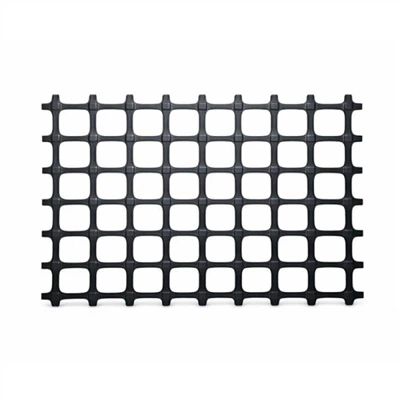
Biaxial Plastic Geogrid is a geosynthetic material made of high - density polyethylene (HDPE) or polypropylene (PP) and is used for soil reinforcement. It has a grid - like structure with ribs in two perpendicular directions, which provides high tensile strength in both the longitudinal and transverse directions.
The Poisson's ratio of Biaxial Plastic Geogrid can vary depending on several factors, including the material properties of the polymer, the manufacturing process, and the structure of the geogrid. Generally, the Poisson's ratio of Biaxial Plastic Geogrid ranges from 0.1 to 0.4.
The relatively low Poisson's ratio of Biaxial Plastic Geogrid is beneficial for soil reinforcement applications. When the geogrid is subjected to an axial load, a low Poisson's ratio means that the transverse contraction is minimized. This helps to maintain the integrity of the geogrid - soil system and prevents excessive lateral deformation of the soil.
Significance of Poisson's Ratio in Soil Reinforcement
In soil reinforcement applications, Biaxial Plastic Geogrid is used to improve the stability and bearing capacity of soil. When the geogrid is installed in the soil, it interacts with the soil particles through friction and interlocking. The Poisson's ratio of the geogrid plays a crucial role in this interaction.
A low Poisson's ratio allows the geogrid to distribute the load more evenly in the soil. When the soil is subjected to an external load, the geogrid resists the deformation and transfers the load to a larger area of the soil. This reduces the stress concentration in the soil and prevents soil failure.
Moreover, a low Poisson's ratio helps to prevent the geogrid from pulling out of the soil. When the geogrid is stretched, a low transverse contraction means that the geogrid maintains a better grip on the soil particles, enhancing the overall stability of the soil - geogrid system.
Applications of Biaxial Plastic Geogrid
Biaxial Plastic Geogrid has a wide range of applications in civil engineering, including road construction, embankment reinforcement, and retaining wall systems.
In road construction, Biaxial Plastic Geogrid is used to reinforce the subgrade and base layers. By improving the load - bearing capacity of the soil, it reduces the thickness of the pavement layers, saving construction costs. You can find more information about Biaxial Plastic Geogrid for road construction on our website Biaxial Plastic Geogrid.
For embankment reinforcement, Biaxial Plastic Geogrid provides stability to the embankment by distributing the load and preventing soil erosion. It is especially useful in areas with soft or unstable soil conditions.
In retaining wall systems, Biaxial Plastic Geogrid is used to reinforce the soil behind the wall. The geogrid helps to increase the lateral stability of the wall and reduces the lateral earth pressure. Check out our Biaxial Geogrids For Soil Reinforcement for more details on this application.
Another important application is in the Steel Plastic Geogrid For Reinforced Soil Retaining Wall System. The combination of steel and plastic in the geogrid provides high strength and durability, making it suitable for large - scale retaining wall projects.
Factors Affecting Poisson's Ratio of Biaxial Plastic Geogrid
Several factors can affect the Poisson's ratio of Biaxial Plastic Geogrid. The type of polymer used in the manufacturing process is one of the most important factors. Different polymers have different mechanical properties, which can result in different Poisson's ratios.
The manufacturing process also plays a role. The stretching and orientation of the polymer during the production of the geogrid can influence its Poisson's ratio. For example, a highly oriented geogrid may have a lower Poisson's ratio compared to a less oriented one.
The structure of the geogrid, such as the rib thickness, rib spacing, and aperture size, can also affect the Poisson's ratio. A geogrid with a denser structure may have a different Poisson's ratio compared to a more open - structured geogrid.
Measuring Poisson's Ratio of Biaxial Plastic Geogrid
To measure the Poisson's ratio of Biaxial Plastic Geogrid, a uniaxial tensile test is typically conducted. In this test, a specimen of the geogrid is subjected to an axial load, and the axial and transverse strains are measured using strain gauges. The Poisson's ratio is then calculated using the formula mentioned earlier.
It is important to note that the Poisson's ratio may vary depending on the test conditions, such as the loading rate and the specimen size. Therefore, it is necessary to follow standardized testing procedures to obtain accurate and reliable results.


Conclusion
The Poisson's ratio of Biaxial Plastic Geogrid is an important mechanical property that affects its performance in soil reinforcement applications. A low Poisson's ratio is beneficial for maintaining the integrity of the geogrid - soil system, distributing the load evenly, and preventing soil failure.
As a supplier of Biaxial Plastic Geogrid, we are committed to providing high - quality products with consistent mechanical properties. Our geogrids are designed to meet the specific requirements of various civil engineering projects.
If you are interested in purchasing Biaxial Plastic Geogrid for your project, we invite you to contact us for further discussion. Our team of experts will be happy to provide you with detailed information and technical support.