

A gold mine tailings storage facility requires more than a competitive price for HDPE geomembrane. Buyers must coordinate material specifications, drainage requirements, installation, quality testing, transportation, and local conformity documentation before construction can proceed.
For a mining project in Kazakhstan with an annual ore processing capacity of 500,000 tonnes, the procurement scope may include 1.5 mm smooth and textured HDPE geomembrane, extrusion welding rod, and 300 and 500 g/m² nonwoven polypropylene geotextile. Where the facility contains multiple lined cells, each material must be matched to the approved design and construction schedule.
This article explains how mining project owners, EPC contractors, and procurement teams can address the main technical and commercial challenges when sourcing geomembrane and geotextile for a tailings facility.
How to Select the Right HDPE Geomembrane for Tailings Storage
The procurement challenge: A project may require both smooth and textured 1.5 mm HDPE geomembrane. Quoting only one surface type or providing a general product brochure does not demonstrate compliance with the project specification.
The solution: Prepare separate technical submissions for smooth and textured geomembranes, using the exact requirements stated in the project questionnaire.
For each product, confirm the nominal thickness, applicable material standard, tensile properties, tear resistance, puncture resistance, stress-crack resistance, oxidative resistance, and other specified parameters. Provide actual test data and identify the relevant test methods.
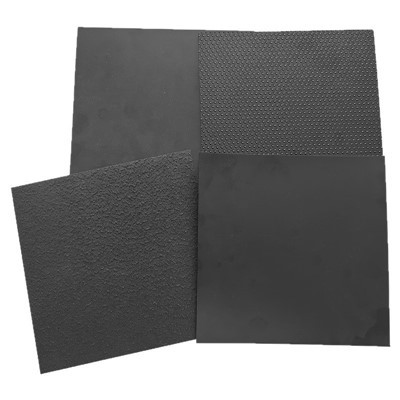
Smooth geomembrane may be suitable for designated floor areas, while textured geomembrane may be specified on slopes where additional interface friction is required. The final material arrangement must follow the approved design and relevant interface shear strength assessments.
For mining projects, the design team should also review tailings-water chemistry, operating temperatures, loading conditions, subgrade quality, and the potential for construction-related damage.
A supplier should not substitute smooth geomembrane for textured material, or change the specified thickness, without written technical approval.



How to Specify 300 and 500 g/m² Nonwoven Geotextile
The procurement challenge: The required mass per unit area is known, but the buyer still needs to confirm whether each geotextile grade meets the project's mechanical and hydraulic requirements.
The solution: Submit separate technical data for 300 g/m² and 500 g/m² needle-punched nonwoven polypropylene geotextiles.
| Specification | 300 g/m² PP Geotextile | 500 g/m² PP Geotextile |
|---|---|---|
| Material | Polypropylene | Polypropylene |
| Manufacturing method | Needle-punched nonwoven | Needle-punched nonwoven |
| Nominal mass per unit area | 300 g/m² | 500 g/m² |
| Thickness | Provide actual test data | Provide actual test data |
| Tensile strength | Confirm against project specification | Confirm against project specification |
| Puncture resistance | Confirm against project specification | Confirm against project specification |
| Hydraulic properties | Confirm where required | Confirm where required |
| Roll width and length | State in quotation | State in quotation |
The geotextile grade should be selected according to its intended function, such as geomembrane protection, separation, or filtration. A heavier product is not automatically the correct choice for every application.
For example, a protection layer beneath drainage aggregate must be assessed against the actual aggregate characteristics, installation loads, and risk of geomembrane puncture. A geotextile used for filtration must also meet the project's retention and permeability criteria.
Before finalizing the order, the supplier and buyer should confirm the installation location of each grade, the required test values, roll dimensions, total quantities, and available quality documents.
How to Complete Technical Questionnaires Without Leaving Procurement Gaps
The procurement challenge: Mining projects frequently use detailed supplier questionnaires. An incomplete response can delay technical approval even when the supplier has the required products.
The solution: Complete every applicable field in the original questionnaire and distinguish verified compliance from deviations and outstanding information.
For the geomembrane package, the supplier should address the specified product properties, surface finishes, welding rod requirements, packaging, inspection records, and delivery conditions.
For the geotextile package, the response should cover the polymer type, mass per unit area, mechanical properties, hydraulic properties where specified, roll dimensions, and testing documentation.
A useful supplier response should contain three elements:
Compliant: The offered product meets the stated requirement, supported by the relevant technical data or test report.
Deviation: The offered product differs from the requirement. The difference and its technical implications must be explained.
Alternative proposal: A substitute is offered for the buyer and design engineer to evaluate and approve.
The supplier should not simply mark every line as compliant without supporting evidence.
If a required test report is unavailable, the response should state whether testing can be arranged, the expected lead time, and any additional cost. If the project documents are incomplete, the outstanding items should be listed clearly rather than replaced with assumptions.
This approach helps the procurement team identify technical gaps before issuing a purchase order.
How to Compare FCA and DAP Prices for a Kazakhstan Mining Project
The procurement challenge: A low factory price may not represent the actual delivered cost of materials at the mine site. Transport, export clearance, packaging, and delivery arrangements can significantly affect the final procurement budget.
The solution: Request two separate commercial quotations using clearly identified delivery points under Incoterms 2020.
| Cost Item | FCA Named Works | DAP Named Site |
|---|---|---|
| Product price | Itemized | Itemized |
| Packaging | State included scope | State included scope |
| Export clearance | Seller's responsibility under FCA | Seller's responsibility |
| Main transportation | Generally arranged by buyer | Arranged by seller |
| Delivery to named destination | According to FCA handover point | Seller arranges delivery to the named site |
| Import clearance | Buyer | Buyer |
| Import duties and taxes | Buyer, as applicable | Buyer, as applicable |
| Unloading at destination | As agreed | Generally the buyer's responsibility |
The exact allocation depends on the named delivery point and the agreed Incoterms 2020 rule.
To prepare a reliable DAP quotation, the buyer should provide the complete site address, expected delivery window, access limitations, unloading arrangements, and any restrictions affecting truck access.
The supplier should then itemize the material quantities, unit prices, totals, currency, production lead time, transport assumptions, quotation validity, and payment terms.
Where freight costs cannot yet be confirmed, the proposal should identify the outstanding logistics information rather than present an unsupported delivered price.
How to Arrange Geomembrane Installation on Cell Floors and Slopes
The procurement challenge: The buyer needs to know whether the supplier can install the liner with its own crew or through a qualified partner. The buyer also requires separate installation rates for flat floors and 1V:3H slopes, together with productivity and mobilization information.
The solution: Establish the installation scope before including installation costs in the commercial proposal.
A complete installation quotation should separate the following work items:
| Installation Scope | Required Commercial Information |
|---|---|
| Geomembrane deployment on cell floors | Price per m² |
| Geomembrane deployment on 1V:3H slopes | Price per m² |
| Geomembrane welding | Price basis and included scope |
| Geotextile installation on floors | Price per m² |
| Geotextile installation on slopes | Price per m² |
| Non-destructive seam testing | Method, scope, and price |
| Destructive seam testing | Testing frequency and price |
| Site supervision | Daily or lump-sum rate |
| Mobilization and demobilization | Separate cost |
| Repair work and retesting | Included scope or separate rate |
A 1V:3H slope is approximately 18.4 degrees from the horizontal. Actual productivity depends on the slope length, anchorage arrangement, panel layout, wind conditions, equipment, access, and safety requirements.
The contractor should provide a realistic work plan covering the number of crews, equipment, expected daily output, working season, mobilization period, and quality-control procedures.
If the material supplier does not have its own installation team, the proposed contractor should be identified as a separate party. The buyer should receive the contractor's company details, contact person, telephone number, email address, relevant mining references, and a clear division of responsibilities.
If a suitable contractor has not yet been verified, the supplier should state this limitation and avoid promising installation availability or rates until the necessary arrangements have been confirmed.
How to Control Welding Quality and Field Testing
The procurement challenge: Even compliant geomembrane can be damaged during deployment or compromised by poor welding. The buyer therefore needs a defined inspection and testing process.
The solution: Require a project-specific installation quality plan before fieldwork begins.
The plan should cover:
Inspection and acceptance of the prepared subgrade.
Geomembrane roll identification and panel layout.
Trial seams and welding equipment checks.
Welding parameter records and seam identification.
Non-destructive seam testing using the specified methods.
Destructive seam sampling at the required frequency.
Defect mapping, repairs, and retesting.
Final inspection records and as-built documentation.
Dual-track fusion seams may permit air-channel testing where the seam design is suitable. Vacuum-box testing may be appropriate for certain seams, patches, and details. The approved quality plan should define the applicable method and acceptance criteria.
Extrusion welding rod must be compatible with the geomembrane and the approved welding procedure. Its specification, dimensions, packaging, and traceability should be included in the procurement documentation.
The buyer should confirm whether testing will be conducted by the installation contractor, an independent testing laboratory, or both.
These responsibilities must be agreed before construction to avoid disputes over failed tests, repair costs, and final acceptance.
What Quality and Conformity Documents Should the Supplier Provide?
The procurement challenge: The project requests test reports and EAEU or Kazakhstan conformity documents. Existing factory certificates may not automatically satisfy the project's regulatory or contractual requirements.
The solution: Prepare a document register that distinguishes available records from documents that require further verification or testing.
| Document | Purpose |
|---|---|
| Technical data sheets | Confirm product specifications |
| Factory quality inspection records | Support production quality control |
| Relevant test reports | Demonstrate measured properties against specified methods |
| Batch or roll identification records | Support material traceability |
| Quality management certificates | Document the applicable management system |
| Product conformity documents | Address applicable regulatory requirements |
| Installation quality records | Document welding, inspection, repairs, and testing |
| Warranty statement | Define coverage, duration, and exclusions |
GRI-GM13 can be used as a reference specification for HDPE geomembrane properties when accepted by the project documents. The applicable edition and any additional project requirements should be confirmed before the supplier declares compliance.
For Kazakhstan, the buyer or importer should confirm the applicable product classification, technical regulations, conformity assessment route, and document issuer with a qualified local compliance specialist.
The supplier should then identify which documents are already available and which require additional testing, certification, or administrative processing.
If new documents are required, the proposal should state the estimated process, cost, and lead time only after the applicable requirements have been confirmed.
How to Verify Mining Experience and Local Installation Support
The procurement challenge: The buyer needs evidence of relevant mining or tailings experience and wants to understand whether the supplier has support in Kazakhstan or the wider CIS region.
The solution: Provide project references that accurately reflect the supplier's role and actual scope of work.
For each relevant project, the supplier should identify the country, application, supplied material, approximate quantity, installation scope, completion date, and available supporting evidence.
Where confidentiality restrictions apply, references may be presented in an anonymized form if permitted by the project owner.
If the supplier has experience with industrial containment or water storage but not a tailings storage facility, the distinction should be made explicit. Similar applications can demonstrate relevant supply capabilities, but they should not be presented as tailings projects.
For local installation support, confirm the availability of the contractor, equipment, personnel, travel arrangements, and site-specific work permits before including them in the proposal.
A supplier without a verified local partner can still provide a transparent material supply quotation and identify installation support as an item requiring separate confirmation.
Can the Supplier Coordinate Other Materials for the Facility?
The procurement challenge: The project may require additional equipment and materials beyond geomembrane and geotextile. Separate sourcing can create coordination problems when technical interfaces and delivery dates are not managed together.
The solution: Establish separate procurement packages and assign a responsible party to each package.
Depending on verified supply capabilities, additional packages may include:
PE pipes and associated fittings.
Pumps and pumping stations.
Paste transport pipelines.
Instrumentation and telemetry.
Electrical equipment.
Modular containers.
Sand, crushed stone, and soil.
Fencing and safety signs.
Monitoring networks and survey equipment.
Dust suppression equipment and machinery.
Precast concrete products.
Geomembrane welding equipment.
Each package should have its own technical specification, quantity schedule, compliance requirements, delivery terms, and quotation.
If a supplier offers items through partner companies, those items should be identified as partner-supplied rather than manufactured in-house.
For complex projects, a consolidated procurement schedule can help the buyer track the delivery status of each package without confusing the technical responsibility of different suppliers.
What Information Is Needed to Finalize the Quotation?
The procurement challenge: A reliable quotation cannot be completed from nominal material specifications alone. Installation prices, freight costs, quantities, and delivery schedules depend on project-specific information.
The solution: Request the documents and clarifications that directly affect the commercial and technical offer.
The buyer should provide:
The completed or blank OL01 and OL02 questionnaires.
Drawings of the six cells, including floor and slope areas.
The quantities of smooth and textured geomembrane, welding rod, and each geotextile grade.
Applicable technical standards and acceptance criteria.
Drainage, protection-layer, and anchorage details.
The full delivery address and required delivery dates.
Installation scope and site access information.
Applicable conformity documentation requirements.
Any additional procurement questionnaires for related equipment.
Once these details are available, the supplier can prepare a more accurate material schedule, identify technical deviations, calculate transport options, and establish a realistic production and installation schedule.
Where an exact requirement cannot be met, the correct response is to explain the limitation and propose a technically justified alternative for the project engineer's approval.
Conclusion: A Practical Procurement Approach for Mining Liner Systems
For a gold mine tailings storage facility, selecting HDPE geomembrane and geotextile is only one part of the procurement process. The project also needs complete technical submissions, transparent commercial terms, verified quality documentation, a realistic installation plan, and clear responsibility for testing and acceptance.
GeosyntheticTech can use a structured procurement approach to help buyers evaluate the required geomembrane and geotextile specifications, organize product documentation, and clarify the information needed for project-specific quotations. Installation, certification, logistics, and additional equipment should be included only where the relevant capabilities and arrangements have been confirmed.
Planning a mining or tailings storage project?
Send your technical specifications, drawings, estimated quantities, delivery destination, and installation requirements to discuss the appropriate geomembrane and geotextile supply scope.
A clearly defined scope helps identify technical gaps early, improve quotation accuracy, and reduce avoidable delays during procurement and construction.


