

Top 10 Dewatering Sediment Filter Bag Suppliers in China
Choosing a suitable dewatering sediment filter bag supplier in China requires more than comparing product prices. Fabric structure, filtration performance, seam strength, bag dimensions, customization capabilities, and project requirements all influence the suitability of a product for sediment control and sludge dewatering.
China has a broad manufacturing base for geotextiles, geosynthetic materials, and sediment management products. However, suppliers differ in their product ranges, manufacturing capabilities, and experience with specific applications.
This article introduces 10 Chinese suppliers associated with dewatering bags, sediment filter bags, geotextile bags, or related geosynthetic products. It is intended to help contractors, distributors, importers, and engineering procurement teams identify potential suppliers for further evaluation.
Ranking Notice: The suppliers are listed for reference only. The order does not represent a ranking of product quality, technical capability, market share, or overall business performance. Buyers should verify each supplier's current product range, technical documentation, and manufacturing capabilities before placing an order.
GeosyntheticTech – Hangzhou Weiwo Technology Co., Ltd.
Website: https://www.geosynthetictech.com/
GeosyntheticTech, operated by Hangzhou Weiwo Technology Co., Ltd., supplies geosynthetic materials for civil engineering, infrastructure, environmental protection, and related construction applications. Its product range includes geotextile dewatering bags, geomembranes, geogrids, and other geosynthetic solutions.
For sediment dewatering projects, selecting the appropriate fabric and bag configuration is essential. Relevant considerations include the type of sediment, required solids retention, water drainage characteristics, bag dimensions, filling conditions, and mechanical loading during operation.
GeosyntheticTech offers OEM and customized geosynthetic solutions, with options for material selection, strength requirements, dimensions, and packaging according to project specifications. These capabilities are relevant to buyers sourcing products for different site conditions and project requirements.
Products and services to discuss with the supplier:
Geotextile dewatering bags and related geosynthetic products
Customized dimensions and material configurations
Fabric strength and filtration requirements
OEM and private-label options
Export packaging and project-specific supply coordination
Best suited for evaluation by: Engineering contractors, geosynthetic distributors, importers, and procurement teams requiring customized product specifications.
Buyers should submit their application details and technical requirements to confirm the appropriate product configuration and obtain a project-specific quotation.


2. Shijiazhuang Boshuo New Material Co., Ltd.
Product reference: Dewatering filter bags and woven geotextile products
Shijiazhuang Boshuo New Material Co., Ltd. is listed in industrial sourcing directories for geosynthetic materials, including PP woven geotextile products and dewatering-related bags or tubes.
For buyers comparing sediment dewatering bag suppliers, the main considerations are the available fabric structures, tensile properties, filtration characteristics, and bag configurations. These details should be checked against the requirements of the intended application rather than inferred from a product title alone.
Before ordering, request current product specifications, available dimensions, seam details, sample availability, and confirmation of whether the company manufactures the required product directly.
Key evaluation points: Woven geotextile options, bag dimensions, technical specifications, and order requirements.
3. Qingdao Haisan New Energy Co., Ltd.
Product reference: Dewatering bags, geotextile tubes, and related geosynthetics
Qingdao Haisan New Energy Co., Ltd. lists geosynthetic products that include dewatering bags, geotextile tubes, and geotextile bags.
This product range makes the company a potential candidate for buyers comparing bag-based sediment management solutions with larger geotextile containment products. The appropriate format depends on the volume of material, the available working area, filling arrangements, and the required drainage behavior.
Procurement teams should distinguish between small sediment filter bags, sludge dewatering bags, and large geotextile tubes. Although these products share some material characteristics, their dimensions, construction, and intended operating conditions can differ substantially.
Key evaluation points: Product format, PP or PET material options, dimensions, fabric properties, and intended application
.
4. Shandong Chuangwei New Materials Co., Ltd.
Product reference: Sediment dewatering bags and sediment filter bags
Shandong Chuangwei New Materials Co., Ltd. lists sediment dewatering bags and sediment bags for applications involving sediment control, sludge management, water filtration, and environmental engineering.
For these applications, fabric permeability must be considered together with particle retention and the characteristics of the material being treated. A fabric that drains water readily may not retain the fine particles required by a particular project. Conversely, excessive resistance to flow can affect dewatering operations.
Buyers should request product-specific technical data and establish whether the proposed bag is intended for pumped construction-site runoff, sediment-laden water, sludge dewatering, or another application.
Key evaluation points: Fabric construction, sediment retention requirements, seam integrity, bag dimensions, and application suitability.
5. Shanghai BlueWave Environmental Solutions Co., Ltd.
Product reference: Dewatering bags and sediment-control products
Shanghai BlueWave Environmental Solutions Co., Ltd. identifies dewatering bags and geotextile bags among its sediment-control and wastewater-related products.
For contractors working on construction sites, excavation projects, or water-management operations, sediment filter bags may provide a practical method of retaining solids while allowing water to drain through the filtration material. The actual result depends on the sediment characteristics, fabric selection, flow conditions, and installation arrangement.
Buyers should clarify the intended use before selecting a product. A bag designed for general sediment control may not be interchangeable with a larger geotextile container intended for high-volume sludge or dredged-material dewatering.
Key evaluation points: Application-specific product selection, fabric properties, bag design, installation requirements, and technical documentation.
6. Yangzhou Leebo Environmental Protection Material Co., Ltd.
Product reference: Cube dewatering bags and sediment filter bags
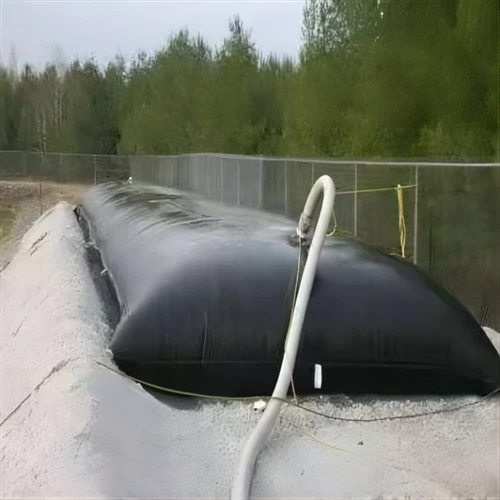
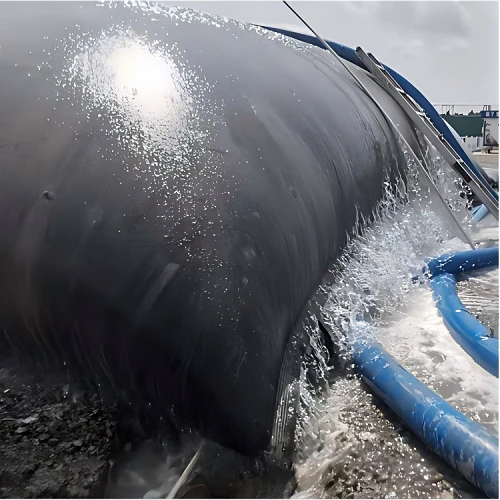
Yangzhou Leebo Environmental Protection Material Co., Ltd. lists cube dewatering bags for filtering sediment-laden water. Such bags can be relevant to construction and excavation projects where pumped water requires sediment separation and a conventional settling area may be impractical.
For these applications, the connection between the discharge hose and the bag is an important design consideration. The inlet configuration, securing method, seam construction, and available drainage area should be compatible with the operating flow and site layout.
Before procurement, ask for the recommended operating conditions, available sizes, inlet details, fabric specifications, and installation instructions.
Key evaluation points: Cube-shaped bag configurations, hose connection, seam construction, drainage performance, and site installation.
7. Taian Dingkun New Material Co., Ltd.
Product reference: Geotextile bags and sediment dewatering products
Taian Dingkun New Material Co., Ltd. appears in industrial sourcing listings for geotextile bags and sediment dewatering products.
Buyers evaluating this supplier should identify the exact product category required. Small geotextile bags for sediment containment, larger dewatering bags, and geotextile tubes serve different operational purposes and should not be treated as equivalent products.
A clear technical inquiry should specify the material to be dewatered, the required bag dimensions, the expected loading conditions, and any requirements for UV exposure or repeated handling.
Key evaluation points: Exact product type, material options, dimensional customization, mechanical properties, and delivery requirements.
8. Zhejiang Chengmei Import & Export Co., Ltd.
Product reference: Sediment dewatering geobags and related products
Zhejiang Chengmei Import & Export Co., Ltd. is listed in online sourcing information for sediment dewatering bags and related geotextile products.
For overseas buyers, product sourcing and export coordination are important alongside the technical suitability of the bag itself. Importers should confirm the manufacturer's identity, the production location, the company's role in the transaction, and which party is responsible for technical documentation and quality checks.
When comparing quotations, ensure that all suppliers are quoting products with comparable dimensions, fabric specifications, seam construction, packaging, and delivery terms.
Key evaluation points: Product availability, sourcing arrangements, specification confirmation, export documentation, and delivery terms.
9. Ningbo Honghuan Geotextile Co., Ltd.
Product reference: Geotextile bags and geotextile tubes
Ningbo Honghuan Geotextile Co., Ltd. is listed in industrial sourcing information for geotextile products, including geotextile tubes and related bag products used in engineering and environmental applications.
Geotextile bags and tubes can be used in different sediment management and containment projects, but product selection depends on the required capacity and operating method. A large containment tube used for dredged sediment requires a different assessment from a small filter bag used at a construction-site discharge point.
Buyers should request confirmation of the company's current sediment dewatering product range and review the technical specifications for the specific product being considered.
Key evaluation points: Bag and tube configurations, material strength, dimensions, application suitability, and manufacturing details.
10. Anhui Zhonglu Engineering Materials Co., Ltd.
Product reference: Geotextile products for engineering and sediment management
Anhui Zhonglu Engineering Materials Co., Ltd. is listed in industrial sourcing information for geotextile products associated with engineering applications, including geotextile tubes and sediment-related uses.
When considering a supplier of engineering geotextiles, buyers should assess more than the product category. The fabric must meet the mechanical and hydraulic requirements of the project, and the finished product must be suitable for its intended filling, handling, and service conditions.
Procurement teams should request current product data, applicable test reports, manufacturing information, and confirmation of the supplier's ability to provide the exact bag configuration required.
Key evaluation points: Engineering geotextile specifications, product configuration, manufacturing capability, technical records, and supply arrangements.
How to Choose a Dewatering Sediment Filter Bag Supplier in China
The right supplier should be selected according to the project requirements rather than company descriptions alone. The following checks can help buyers make a more informed comparison.
1. Confirm the Intended Application
Identify whether the bags will be used for construction-site dewatering, stormwater sediment control, excavation runoff, wastewater treatment, dredged sediment, or industrial sludge.
These applications can require different fabric properties, bag dimensions, and operating arrangements.
2. Review Fabric and Filtration Properties
Request the actual technical specifications for the proposed product.
| Parameter | What Buyers Should Confirm |
|---|---|
| Material | Polypropylene (PP), polyester (PET), or another specified polymer |
| Fabric structure | Woven, nonwoven, or another defined construction |
| Fabric mass | Measured in g/m², where applicable |
| Tensile strength | Test method, direction, and reported value |
| Apparent opening size | AOS or equivalent opening-size data, where applicable |
| Permittivity or permeability | Test method and reported value |
| Seam strength | Test results or documented construction requirements |
| Bag dimensions | Length, width, depth, and allowable tolerances |
Values should be selected for the actual project. There is no single fabric weight, opening size, or strength value that is suitable for every sediment dewatering application.
3. Examine Bag Construction
The fabric is only one part of the finished product. Seams, inlet openings, reinforcement, lifting arrangements, and closure details can influence performance during filling and handling.
For pumped sediment filter bags, confirm that the inlet and securing arrangement are compatible with the discharge hose. For larger dewatering bags or tubes, confirm the loading and handling requirements before production.
4. Verify Manufacturing and Quality-Control Capabilities
Ask whether the supplier manufactures the finished bags in-house or sources them from another manufacturer. Request relevant production details, inspection procedures, and test reports.
Where compliance is required, specify the applicable standard and test method. General claims about certification should not be treated as evidence that a particular product complies with the project specification.
5. Compare Quotations on an Equivalent Basis
A lower quotation does not necessarily represent a lower total project cost. Differences in material, dimensions, seam construction, packaging, quantity, and delivery terms can make quotations difficult to compare.
Provide the same specification to each supplier and compare the resulting offers on a consistent basis.
Common Applications of Dewatering Sediment Filter Bags
Dewatering sediment filter bags are used in various water-management and environmental applications. The product configuration should match the solids, flow conditions, and site constraints.
Construction-site dewatering: Retaining sediment in water pumped from excavations and construction areas.
Stormwater management: Helping control sediment discharge during site drainage operations.
Dredging and river maintenance: Supporting the separation and containment of sediment-laden material.
Wastewater and sludge management: Facilitating water drainage from suitable sludge streams, subject to material compatibility and process requirements.
Environmental remediation: Providing a containment and dewatering option for selected sediment-management operations.
For contaminated sediment or industrial sludge, confirm the chemical compatibility of the material and establish appropriate procedures for handling and disposal of the retained solids and discharged water.
Frequently Asked Questions
What Is Your Estimated Pumping Flow Rate (GPM) or Hose Size?
Please provide the estimated pumping flow rate in gallons per minute (GPM) or the inside diameter of your discharge hose. This information helps us evaluate the bag size, inlet configuration, and required drainage capacity. If the flow rate is unknown, the pump model, hose diameter, and expected operating conditions can help us assess a suitable configuration. Final selection should also account for sediment concentration and particle size.
Are You Working on a Municipal, Commercial Construction, or Dredging Site?
Please specify the project type and the source of the sediment-laden water. Municipal drainage, commercial construction, and dredging projects can involve different sediment characteristics, discharge requirements, and operating conditions. This information helps us evaluate the appropriate geotextile material, bag dimensions, and filtration requirements for your application. If available, please also provide the project specifications or site conditions for a more accurate assessment.
Do You Need Oil-Retention Capabilities Alongside Standard Sediment Filtering?
Please confirm whether the water contains oil, fuel, or other petroleum-based contaminants in addition to suspended sediment. Standard sediment filter bags are primarily designed to retain solids and should not be assumed to remove dissolved oil or free oil effectively. If oil retention is required, we need to assess the contaminant type, concentration, applicable discharge limits, and compatibility of the proposed filtration system. Additional oil-separation or oil-absorbent treatment may be necessary to meet your project requirements.
What is the difference between a sediment filter bag and a geotextile dewatering bag?
A sediment filter bag commonly refers to a bag used to retain suspended solids in pumped water. A geotextile dewatering bag may also be designed to contain and dewater larger volumes of sludge or sediment. Product names vary between suppliers, so the intended application and technical specifications should be confirmed.
Which material is commonly used for dewatering sediment filter bags?
Polypropylene and polyester are used in geotextile products, with the appropriate choice depending on the fabric construction, required mechanical properties, chemical exposure, and operating conditions. The polymer alone does not determine filtration performance.
Can dewatering sediment filter bags be customized?
Customization may include bag dimensions, fabric specifications, inlet design, seam construction, reinforcement, packaging, and labeling. Buyers should confirm which options are available for the specific product and order quantity.
What information should buyers provide when requesting a quotation?
Provide the intended application, material to be filtered, estimated quantity, required bag dimensions, relevant technical specifications, delivery destination, and any applicable compliance requirements. If the exact specifications are not yet available, provide project drawings, photos, or a description of the operating conditions.
How can buyers compare Chinese suppliers fairly?
Use the same technical specification and commercial requirements for every quotation. Compare fabric properties, finished-bag construction, test documentation, customization options, order quantities, lead times, packaging, and delivery terms.


