

Geogrid Reinforced Retaining Walls: Benefits, Applications and How to Choose a Reliable Supplier
Retaining walls are essential structures in modern infrastructure projects such as highways, railways, ports, and slope stabilization systems. Traditional concrete retaining walls often require large amounts of materials, complex construction processes, and high costs.
Today, geogrid reinforced retaining walls have become a widely adopted engineering solution. By reinforcing soil with high-strength polymer geogrids, engineers can significantly improve soil stability, reduce lateral earth pressure, and construct cost-effective retaining structures.
This article explains how geogrids work, their advantages in retaining wall systems, typical engineering applications, and how international contractors can choose a reliable geogrid supplier.

What Is a Geogrid Reinforced Retaining Wall?
A geogrid reinforced retaining wall is a soil stabilization structure where layers of geogrid are embedded within compacted backfill to form a reinforced soil mass. This system is also known as a mechanically stabilized earth (MSE) retaining wall.
The open grid structure of geogrids allows soil particles to interlock with the polymer ribs. This interaction transforms loose soil into a stronger composite material capable of supporting significant loads. Geogrids are typically made from materials such as HDPE, polypropylene, or polyester.
The reinforced soil mass works together with facing panels or concrete blocks to resist soil pressure and stabilize slopes. This technique has been widely used in civil engineering projects worldwide.
How Geogrids Work in Soil Reinforcement
The reinforcement mechanism of geogrids is based on mechanical interlocking and tensile resistance. When geogrids are installed between layers of compacted soil, they restrict lateral soil movement and distribute loads over a larger area.
The main functions of geogrid reinforcement include:
- Improving soil shear strength
- Reducing lateral earth pressure
- Preventing soil displacement
- Increasing load-bearing capacity
Studies show that properly designed geogrid systems can reduce lateral wall pressure by more than 50% compared with unreinforced soil structures.
Types of Geogrids Used in Retaining Wall Construction
Uniaxial Geogrids
Uniaxial geogrids are designed with high tensile strength in one direction. They are widely used in retaining walls where reinforcement is primarily required against horizontal earth pressure.


Biaxial Geogrids
Biaxial geogrids provide strength in both longitudinal and transverse directions and are commonly used in road base stabilization and foundation reinforcement.
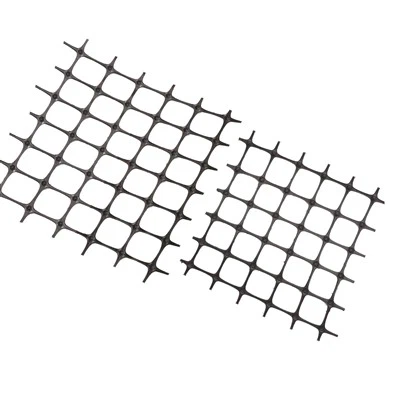


Triaxial Geogrids
Triaxial geogrids feature triangular aperture structures designed to distribute loads more evenly across multiple directions, improving stability under heavy traffic loads.


Advantages of Geogrid Reinforced Retaining Walls
Compared with traditional reinforced concrete retaining walls, geogrid reinforced soil structures offer several advantages.
- Lower construction cost – Reduced concrete and steel consumption
- Faster installation – Modular construction with layered compaction
- Improved flexibility – Better tolerance to settlement and ground movement
- Environmental sustainability – Lower carbon footprint
- Long service life – Modern geogrids can last 75–100 years
These benefits make geogrid reinforced retaining walls increasingly popular in modern infrastructure projects.
Major Applications in Infrastructure Projects
Geogrid reinforced retaining walls are widely used in civil engineering and environmental projects.
Common applications include:
- Highway embankments and road widening projects
- Railway slope stabilization
- Bridge abutments
- Landfill slope protection
- Industrial site development
- Port and coastal engineering
Design Considerations
Proper design is essential to ensure the stability of geogrid reinforced retaining walls. Engineers typically evaluate several factors:
- Soil properties and compaction
- Wall height and slope angle
- Drainage conditions
- Geogrid tensile strength
- Spacing and length of reinforcement layers
Typical reinforcement length ranges from 0.7H to 1.0H of wall height, depending on soil conditions and load requirements.
How to Choose a Reliable Geogrid Supplier
For international contractors and procurement teams, selecting the right geosynthetic supplier is essential for project success.
Important evaluation factors include:
- ISO quality management certification
- Compliance with ASTM or CE standards
- Large-scale manufacturing capability
- Technical engineering support
- Export experience for international projects
Recommended Geosynthetic Manufacturer
For overseas buyers looking for reliable geosynthetic materials, Hangzhou Weiwo Geosynthetic is a professional manufacturer specializing in geogrids and other geosynthetic products used in infrastructure and environmental engineering.
- Complete range of geosynthetic products
- Stable production capacity
- Strict quality inspection
- Engineering technical support
- Global export experience
Learn more about their geosynthetic solutions here:
https://www.geosynthetictech.com
Future Trends in Geosynthetic Reinforcement
As global infrastructure continues to expand, geosynthetic technologies are evolving rapidly. Future innovations include higher-strength polymer materials, improved durability for extreme climates, and integration with smart monitoring systems.
These developments will further increase the adoption of geogrid reinforced retaining walls in infrastructure, transportation, and environmental engineering projects worldwide.
Conclusion
Geogrid reinforced retaining walls represent one of the most efficient and cost-effective solutions for soil stabilization and infrastructure development. By combining geogrids with compacted soil, engineers can create durable retaining structures that reduce construction costs while improving long-term stability.
For contractors, distributors, and infrastructure developers, partnering with experienced manufacturers such as Hangzhou Weiwo Geosynthetic ensures access to high-quality geosynthetic products and reliable technical support for projects around the world.


