

What Is Geogrid for Retaining Walls? A Practical Guide for Engineers & Contractors
Retaining walls are widely used in road construction, landscaping, infrastructure projects, and slope stabilization. However, traditional gravity walls made purely of concrete or stone can be expensive and may fail when soil pressure becomes too high.
This is where geogrids for retaining walls play an important role.
Geogrid reinforcement allows engineers to stabilize soil, improve load distribution, and construct stronger retaining structures with less material. In modern civil engineering, geogrid-reinforced retaining walls are one of the most efficient and cost-effective solutions.
This guide explains what geogrids are, how they work in retaining walls, their benefits, applications, and how to choose the right type.
What Is a Geogrid for Retaining Walls?
A geogrid for retaining walls is a geosynthetic reinforcement material made from polymer materials such as HDPE, polypropylene (PP), or polyester (PET). It features an open grid structure that allows soil particles to interlock with the grid, creating a mechanically stabilized soil structure.
When used behind a retaining wall, the geogrid layers extend into the soil backfill, forming a reinforced soil mass that works together with the wall facing.
This system is commonly referred to as a Mechanically Stabilized Earth (MSE) wall.
Key Characteristics
Typical properties of retaining wall geogrids include:
High tensile strength
Excellent soil interlocking capability
Long-term durability
Resistance to chemicals and biological degradation
Low creep deformation
Because of these properties, geogrids are widely used in civil engineering and geotechnical construction projects worldwide.
How Geogrids Work in Retaining Walls

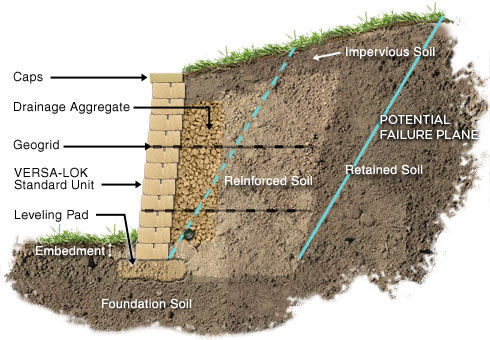


The function of geogrids in retaining walls is based on soil reinforcement principles.
1. Soil Interlock
The open grid structure allows soil particles to penetrate the apertures, creating a mechanical interlock between soil and geogrid.
This increases the shear resistance of the soil mass.
2. Tensile Reinforcement
Soil is strong in compression but weak in tension.
Geogrids provide tensile strength, allowing the reinforced soil mass to resist lateral earth pressure behind the retaining wall.
3. Load Distribution
Geogrid layers distribute loads across a larger area of soil, which helps:
Reduce localized stress
Prevent soil movement
Improve structural stability
4. Formation of Reinforced Soil Mass
Multiple layers of geogrids placed at different elevations create a reinforced soil block that acts as a single stable structure together with the wall facing.
Benefits of Using Geogrids in Retaining Walls
From the perspective of contractors, developers, and project owners, geogrids provide several advantages.
1. Lower Construction Cost
Compared with massive concrete retaining walls, geogrid-reinforced walls:
Require less concrete
Reduce foundation requirements
Use locally available backfill
This can reduce project costs significantly.
2. Faster Installation
Geogrids are lightweight and easy to install.
Construction typically involves:
Installing the wall facing units
Placing backfill soil
Laying geogrid layers
Compacting soil
This process is much faster than traditional reinforced concrete walls.
3. Improved Structural Stability
Geogrids help resist:
Soil pressure
Settlement
Slope instability
Seismic loads
This improves the long-term performance of retaining structures.
4. Flexibility and Crack Resistance
Unlike rigid concrete walls, geogrid-reinforced walls are flexible structures, allowing them to accommodate minor ground movement without cracking.
5. Longer Service Life
High-quality geogrids are designed for 50–120 years of service life, making them suitable for infrastructure projects.
Types of Geogrids Used for Retaining Walls
Different geogrids are selected depending on project requirements.
1. Uniaxial Geogrids
Uniaxial geogrids provide high tensile strength in one direction, making them ideal for retaining wall reinforcement where loads are mainly horizontal.
Typical uses:
MSE retaining walls
Bridge abutments
Steep slopes
2. Biaxial Geogrids
Biaxial geogrids offer strength in two directions, making them suitable for:
Pavement base reinforcement
Soil stabilization
They are less commonly used for high retaining walls.
3. Polyester (PET) Geogrids
PET geogrids are often used for heavy-duty retaining walls due to their:
High tensile strength
Excellent creep resistance
Long-term durability
Typical Applications of Geogrid Reinforced Retaining Walls


Geogrid retaining walls are widely used in many infrastructure and landscaping projects.
Road and Highway Construction
Highway embankments
Bridge approaches
Road widening projects
Railway Infrastructure
Track embankment stabilization
Retaining structures near railways
Commercial and Residential Landscaping
Garden retaining walls
Terrace landscaping
Parking lot retaining walls
Industrial and Infrastructure Projects
Port facilities
Airport runways
Industrial platforms
How to Choose the Right Geogrid for Retaining Walls
Selecting the correct geogrid depends on several engineering factors.
Key considerations include:
Wall height
Higher walls require higher tensile strength geogrids.
Soil properties
The friction angle and particle size of backfill soil affect reinforcement performance.
Load conditions
Traffic loads, building loads, or seismic loads influence design requirements.
Durability requirements
Environmental conditions such as chemicals, UV exposure, and groundwater must be considered.
For most projects, engineers follow international design standards such as FHWA or BS8006 for reinforced soil walls.
Recommended Geogrid Supplier: Hangzhou Weiwo Geosynthetic
If you are looking for a reliable supplier of geogrids for retaining walls and soil reinforcement projects, Hangzhou Weiwo Technology Co., Ltd. is a professional manufacturer specializing in geosynthetic materials for global infrastructure applications.
The company provides a full range of geosynthetic products, including uniaxial geogrids, biaxial geogrids, triaxial geogrids, geotextiles, geomembranes, and geocells, which are widely used in retaining walls, road construction, slope stabilization, landfills, and hydraulic engineering projects.
Why Engineers and Contractors Choose Weiwo
Wide range of geogrid types for different soil reinforcement applications
Custom specifications available (strength, aperture size, width, coating)
Engineering technical support from product selection to installation guidance
International standards compliance including ASTM, ISO, and EN testing requirements
Stable bulk supply for infrastructure projects
Weiwo focuses on delivering high-performance geosynthetic solutions that improve soil stability, load distribution, and long-term infrastructure durability. Their products are commonly used in roads, railways, retaining walls, embankments, and environmental engineering projects worldwide.


