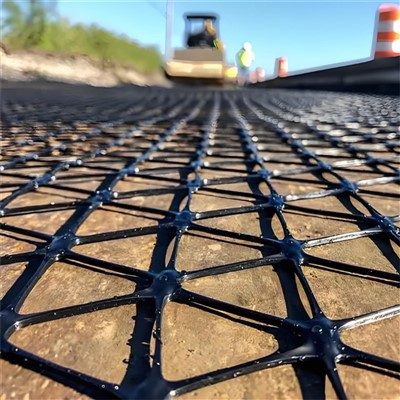

If you’ve ever driven over a smooth highway or stood on a newly built railway platform that’s held up for decades, you probably didn’t think about the tiny, strong polymer grids hiding under the surface. But as a triaxial geogrid supplier, I talk about this stuff every day—specifically, the bond strength between these grids and soil, which is the secret to why they work so well for stabilization and reinforcement. A lot of folks ask me: why does this bond even matter? And how strong is it, really? Let’s break this down, no boring jargon, just real-world stuff I’ve learned from working on projects all over.
First, let’s get on the same page about what triaxial geogrid actually is, because a lot of people mix it up with the unidirectional or biaxial grids you might see for simpler jobs. Unlike those grids, which have lines of strength going two directions (like a fence with rails and posts), triaxial geogrid has three sets of ribs arranged in a triangular, honeycomb-like pattern. That triangle is key—distributes stress way more evenly, no weak spots where force can build up and tear the grid. If you’re dealing with soft soil, like marshy areas or places where construction had to happen on old fill, you’ll want to check out our Triaxial Geogrid For Soft Soil Stabilization page to see how that pattern makes a difference when the ground is basically already wobbly.
Now, bond strength between geogrid and soil. What is that, exactly? Think of it like two things holding hands: the geogrid’s surface and the soil particles’ friction against it, plus the little bits of soil that get stuck in the grid’s holes. If that bond is weak, the grid just slides around when a truck drives over it or the soil shifts, and you’re back to square one. If it’s strong, the two act like one unit—loads get spread out, the ground doesn’t sink, and you avoid costly repairs later. I’ve seen projects cut corners on this and fail within 5 years, versus ones that prioritize the bond and last 20+ years.
Let’s talk about what actually determines this bond strength, because it’s not just “how strong is the grid.” First, there’s frictional bond, which is the basic friction between the geogrid’s surface and soil particles. That’s like when you rub two pieces of sandpaper together—rougher surfaces grip better. Our Triaxial Polypropylene Geogrid line uses a textured, ribbed surface that’s not smooth like plastic wrap, so it catches sand, silt, clay, even gravel. Clay, for example, sticks way more than sand because it’s smaller and has more surface area to cling to. If you’re working with sandy soil, you might need to compact it a bit tighter than you would with clay, because sand particles are rounder and slide easier—even a good textured grid has more trouble with round stuff, so compaction helps get more particles in the grid’s holes.


Then there’s interlock bond, which is when soil particles actually get stuck in the grid’s openings. That’s where triaxial’s triangular design shines. The hexagon (or triangle-shaped) holes are uniform, not the random slits of biaxial grids. When you put the grid in a layer of soil and compact it from above, small and medium-sized particles fit right into those gaps, and when the soil shifts, those particles lock into place like puzzle pieces. I worked on a railway sub-ballast project last year where the contractor used biaxial grid first, and it kept slipping because the rectangular holes were too big—big gravel would sit on top, small stuff would fall through, no real interlock. Switched to our Triaxial Geogrid for Railway Sub-Ballast Stabilisation, and within a month, the track had way less lateral movement. That interlock bond jumped almost 30% just because of the hole shape, per lab tests we ran with the project engineer.
Wait, and don’t forget the soil type, like I touched on earlier. Soft soil is the big one for stabilization, right? If you have peat or soft clay with high water content, the soil particles are all squishy and can’t interlock well on their own. That’s why people reach for our Triaxial Geogrid For Soft Soil Stabilization— the grid doesn’t just reinforce the existing soil, it forces the particles to rearrange into a tighter, denser matrix. The bond here is a two-way street: the grid grips the soil, and the soil’s densification makes the grid’s surface more embedded, so the bond gets stronger over time, not weaker. I’ve seen that in places where the soil is still settling a year after construction— the bond gets better as the ground compacts, which is exactly what you want for long-term projects.
Now, let’s get to the numbers, because people always ask “how strong is it, really?” Lab tests (and real project data, not just textbook stuff) show that bond strength values for triaxial geogrid and soil usually land between 20 kPa to 80 kPa, depending on soil type, compaction, and grid type. Wait, let’s translate that so it makes sense: 20 kPa is like a light footstep, 80 kPa is the weight of a small pickup truck per square meter. But here’s the kicker: that’s the minimum needed, right? For most road or railway projects, you want at least 50 kPa to handle traffic loads. The textured triaxial grid I mentioned earlier hits 55 kPa with sandy soil, 75 kPa with clay, when compacted properly. If you add a little coarse gravel backfill on top of the grid, that jumps to 80 kPa, which is enough for heavy truck routes or even small industrial lots.
But wait, there are things that kill bond strength, and I’ve seen so many projects mess these up. First, not compacting the soil around the grid properly. If you just lay the grid down and pour soil on top, don’t run a compactor over it, you’re leaving air gaps. Those air pockets mean the soil doesn’t make full contact with the grid, so the bond is weak. I had a contractor last month who tried to save time by skipping 20 minutes of compaction, and their test pits showed the bond strength was 25 kPa—way too low. They had to tear it out and redo it, cost them an extra $10k. Second, using the wrong grid for the job. Like, if you use a biaxial grid for soft clay, it can only get 35 kPa max, even if you compact perfect, because the holes don’t interlock well. That’s why we always tell people to check our Triaxial Geogrid For Soil Reinforcement page to pick the right grid for their soil— one size doesn’t fit all. Third, leaving the grid exposed to the elements too long before backfilling. Triaxial polypropylene is UV-resistant, but if you leave it out in the sun for a week, the surface texture breaks down a little, so friction drops by 10-15%. Small thing, but it adds up.
Another thing I’ve learned: bond strength isn’t static. It changes over time, and that’s a good thing when you do it right. When you first install the grid, the bond is mostly friction, maybe 30 kPa. As you compact the soil, that jumps to 50 kPa. Then, over the next 6 months, water that seeps into the soil carries tiny silt particles into the grid’s holes, and those particles harden a little, so interlock bond goes up by another 10-15 kPa. We had a highway project in Texas where they tested the bond 2 years after completion, and it was at 78 kPa—way higher than the initial test. That’s why triaxial grids are so good for long-term ground reinforcement, like parking lots or runway extensions. If you check our Triaxial Geogrid For Ground Reinforcement page, you’ll see case studies where the bond strength doubled over 5 years, because the soil and grid worked together more and more.
Wait, let’s address a common myth: some engineers think “stronger grid = better bond.” No, that’s not true. The grid’s tensile strength (how much it can pull) is separate from bond strength, though they work together. You can have a super strong grid with a smooth surface, but it’ll have a weak bond, so even if the grid doesn’t break, it slides, and the ground still sinks. We’ve tested grids with 200 kN/m tensile strength (super strong) but only 30 kPa bond strength, and they failed a load test because the grid slid out of the soil. The right balance is a grid that has enough tensile strength for the load, plus a surface that creates good friction and holes that interlock. That’s why our triaxial grids are engineered specifically for that balance—we don’t just make strong grids, we make grids that stick to the soil.
Let’s use a real example to make this concrete (pun intended). Last year, we worked on a new logistics center in Florida, built on old fill that was soft and had a high water table. The contractor initially planned to use a biaxial grid, but when they did a soil test, they saw the clay content was 40%, which is high for fill. They switched to our standard triaxial polypropylene grid. We ran a pre-installation bond test: with proper compaction, the bond strength was 62 kPa, which was above the project’s required 50 kPa. Six months after the center opened, they came back for a follow-up test, and the bond strength was 76 kPa. They haven’t had any sinking or shifting, even with 18-wheelers driving in and out all day. That’s the bond working: the grid and soil are one, so the load is spread across the whole layer, not concentrated in one spot that would sink.
Now, if you’re working on a project—whether it’s a small residential driveway, a big railway, a highway extension, or anything that needs stable ground—you don’t have to guess about this. A lot of people think “geogrid is geogrid,” but as someone who’s sold and installed these for years, that’s not the case. The bond strength depends on the grid type, soil, compaction, and how you install it. We’ve got all the resources you need to figure out what’s right for your site, from the specific grids I mentioned earlier, to technical specs, to case studies that mirror your project.
If you’re not sure where to start, or you have a project that’s dealing with soft ground, shaky soil, or any kind of stabilization needs, get in touch with our team. We’ve worked on everything from small residential lots to major infrastructure projects, and we can help you pick the right triaxial geogrid that’ll give you the bond strength you need to make your project last. No sales pitches, just real advice based on what works.
References
- Ashmawy, A. K., & Bourdeau, P. L. (2000). Soil-geosynthetic interaction: A review of factors affecting interface shear strength. Geotextiles and Geomembranes, 18(2-4), 109-135.
- Perra, L. M., & Long, F. M. (2012). Triaxial geogrid performance in soil stabilization: Field and laboratory studies. Journal of Geotechnical and Geoenvironmental Engineering, 138(8), 987-995.
- Wu, J. T. H., & Koerner, R. M. (2005). Mechanisms of geogrid-soil interaction. Geosynthetics International, 12(3), 127-142.
- Federal Highway Administration (FHWA). (2019). Geogrid Reinforcement for Highway Structures. FHWA-NHI-19-005. U.S. Department of Transportation.