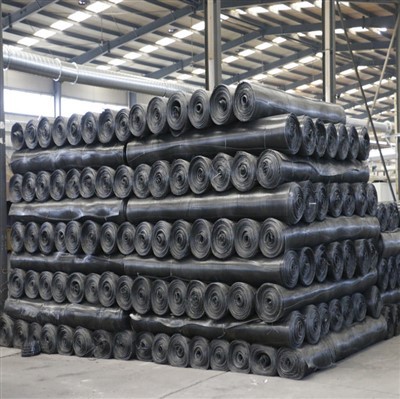
When I first started working as a geogrid supplier over a decade ago, I used to think biaxial plastic geogrid was just another construction material—something that went down between layers of soil and did its job out of sight. But as I’ve spent years on job sites, talking with engineers, watching soil behave in ways no textbook ever predicted, I’ve learned that the interaction between this material and soil is way more fascinating than it looks. It’s not just about placing a grid and calling it done; it’s about a dance between polymer and particle, tension and friction, that makes roadways last longer, slopes stay stable, and building foundations hold up when they shouldn’t. Today, I want to walk you through that interaction, from the first moment geogrid touches soil to the years it performs under heavy traffic or shifting ground.
Let’s start with the basics, because if you don’t understand the core of biaxial plastic geogrid, you can’t grasp how it works with soil. Unlike uniaxial geogrids that only have strength in one direction, biaxial types have equal or near-equal tensile strength in both the machine and cross-machine directions. That’s why they’re perfect for soil reinforcement—they can resist forces pulling in two directions at once. Our clients often ask us: why plastic, specifically? The PP (polypropylene) material we use for most standard biaxial geogrids is tough, corrosion-resistant, and has a high strength-to-weight ratio. You can learn more about this in detail on our page for [PP Biaxial Geogrid], but for now, just know it’s engineered to be rigid enough to carry loads but flexible enough to fit against soil particles.
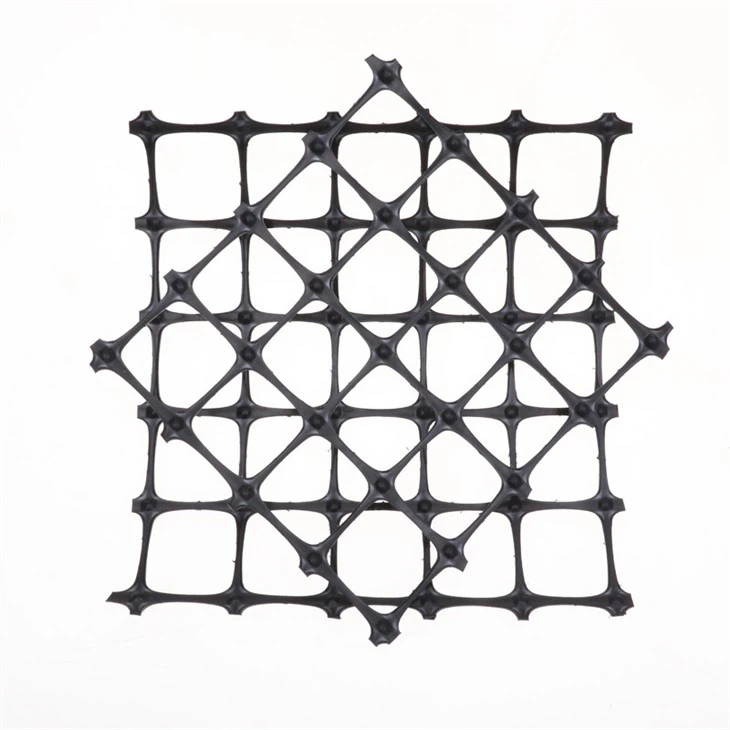
The first thing that happens when geogrid is installed is contact with soil particles, and this is where the magic of mechanical interlocking begins. I remember a job site in rural Ohio a few years back where we were reinforcing a weak subgrade for a county road. The soil there was mostly silty sand—small particles that don’t hold together well on their own. When we laid the biaxial geogrid down and brought in construction traffic to move aggregate on top, the soil started to sink a little, but instead of spreading out like it would have without the grid, it got trapped in the openings of the geogrid’s square or rectangular ribs. Those openings aren’t just empty space; they’re the key to how the two materials work together.
Think of it like this: each soil particle that falls into a geogrid’s hole gets held by the surrounding ribs. When a load is applied—whether that’s a truck wheel pressing down on the road or gravity pulling a slope of soil downhill—those particles can’t move individually. They have to pull on the geogrid, and the geogrid pulls back. That’s mechanical interlocking, and it’s the most fundamental interaction between biaxial plastic geogrid and soil. I’ve seen this play out in lab tests too, where engineers measure the shear strength of soil with and without geogrid. The test results always show a jump in shear strength when geogrid is present, exactly because those particles are now connected through the grid.
But mechanical interlocking isn’t the only force at work here. There’s also friction—both internal and between the geogrid and soil. When the geogrid is placed between soil layers, the surface of the plastic ribs creates friction with the adjacent soil particles. This friction doesn’t sound like much, but when you multiply it over thousands of square feet of geogrid, it adds up to a huge amount of resistance to movement. On steep slopes, for example, this friction keeps the geogrid from sliding along the soil surface, so the interlocked particles stay in place. We also work with [Steel Plastic Geogrid] for some specialized projects, and one of the reasons engineers choose that type is because the steel reinforcement adds extra surface roughness, increasing that frictional interaction with coarse or gravelly soils.
Wait, let’s talk about how the biaxial structure makes this different from other geosynthetics. Woven geotextiles, for example, use friction from their fabric fibers, but they don’t have the rigid ribs to create that mechanical interlocking. Uniaxial geogrids only have strength in one direction, so if the soil is being pulled or pushed in two different directions, they don’t perform as well. Biaxial geogrids, on the other hand, distribute loads evenly across both axes. That means when a truck turns, putting force along both the length and width of the road, the geogrid can resist that force in both directions, keeping the soil layers from separating. Our [Bx Geogrid] line is designed specifically for this balanced strength, and we’ve found it’s the most popular choice for road subgrade reinforcement because of how consistently it interacts with soil in both directions.
Another critical part of this interaction is how the geogrid distributes stress. Soil, especially weak soil like clay or loose sand, can’t handle concentrated loads. If you put a load on a small area of soil, it will sink or collapse. But when you place biaxial geogrid between the soil and the overlying aggregate, the geogrid takes that concentrated load and spreads it out over a much larger area of soil. That’s called load distribution, and it’s a huge reason roads reinforced with geogrid last 20 to 30 years instead of 10. Let me give you a real example: a housing development we worked on in Texas a few years ago had soft, expansive soil that would shift with changes in moisture. Without reinforcement, the driveways were cracking within a year. After installing biaxial plastic geogrid under the concrete, the driveways have held up for over 12 years now. The geogrid didn’t just add strength—it spread the weight of cars and trucks evenly across the soil, preventing the uneven settling that causes cracks.
But it’s not just about how the geogrid handles static loads. We also see interaction with dynamic loads, like the repeated weight of traffic on a road. Over time, trucks bouncing over potholes or uneven pavement put cyclic stress on the soil and geogrid. Biaxial plastic geogrid is designed to resist this cyclic loading—its tensile strength doesn’t drop off significantly even after thousands of load cycles. That’s because the way it interacts with soil means the load is transferred gradually, not in sudden jolts. The soil particles and geogrid work together to absorb the repeated stress, so the soil doesn’t get compacted unevenly or develop shear cracks. For projects with heavy traffic, like highways or industrial access roads, engineers often specify high-tensile biaxial geogrids, and our [Biaxial Geogrids For Soil Reinforcement] page has detailed specs on how our products perform under these dynamic conditions.
I want to address a common question I get: does soil type change how biaxial plastic geogrid interacts with it? The short answer is yes, a lot. For coarse-grained soils like sand or gravel, mechanical interlocking is the dominant interaction. The large particles fit perfectly into the geogrid’s openings, creating a very strong connection. For fine-grained soils like clay, mechanical interlocking is less obvious because the small particles fill the openings, but friction and load distribution become more important. Clay soils also have a tendency to expand and contract with moisture, so the geogrid acts as a tension member, holding the soil together when it shrinks and distributing the stress when it expands. We even have a specialized product for fine-grained soils: our [High-Tensile Steel Plastic Geogrid 30-120kN] has a higher rib strength, which works well with clay’s tendency to exert more lateral pressure.
One thing that surprises a lot of new engineers is how installation quality affects this interaction. If geogrid is laid incorrectly—with wrinkles, overlaps that are too small, or not stretched tight enough—it can’t do its job. I’ve seen a project where a crew installed biaxial geogrid without stretching it, so it was just lying loose on the soil. When the aggregate was put on top, the geogrid bunched up, and the soil under it settled unevenly. The project had to be redone, which cost time and money. When installed correctly, though—stretched to 80% of its maximum tensile strength, overlapped at least 12 inches, and free of wrinkles—the geogrid creates a continuous network that interacts with the entire soil layer, not just small sections. That’s why we always emphasize proper installation training to our clients; the best geogrid in the world won’t perform if it’s not installed right.

We also have to talk about long-term performance. The interaction between biaxial plastic geogrid and soil doesn’t stop once the project is finished. Over years, the geogrid and soil particles can bond more tightly as dust and fine particles work their way into the ribs. For PP biaxial geogrids, the polymer is resistant to UV light and chemical exposure from most soils, so it doesn’t degrade over time. That means the mechanical interlocking, friction, and load distribution stay consistent for decades. In fact, many old roads that were reinforced with geogrid in the 1980s are still in good condition today, with the geogrid still interacting effectively with the soil.
Let’s put all this together to answer the core question: how does biaxial plastic geogrid interact with soil? It’s a multi-step, multi-force process. First, when the geogrid is installed, its ribs create contact with soil particles, starting friction. Then, as loads are applied, soil particles move into the geogrid’s openings, creating mechanical interlocking that holds the particles in place. The biaxial structure distributes loads in two directions, preventing concentrated stress that would damage the soil. Friction between the geogrid and soil keeps the grid from sliding, while load distribution spreads heavy weights over larger areas. For different soil types, different interactions are dominant, but all work together to create a stronger, more stable soil matrix. And with proper installation, this interaction lasts for decades, making projects more durable and cost-effective.
If you’re working on a project that needs soil reinforcement—whether it’s a road, slope, foundation, or retaining wall—understanding this interaction is key to choosing the right product. Our team has worked on hundreds of projects across different soil types and applications, and we can help you pick the right biaxial geogrid for your needs. Whether you need standard PP biaxial geogrid for a residential driveway, steel plastic geogrid for a heavy industrial road, or a high-tensile option for a steep slope, we have the products and expertise to support you. Contact us today to discuss your project and learn more about how our geogrids can work with your soil to create stable, long-lasting structures.
References
- Bathurst, R. J., & Alfaro, M. C. (2019). Reinforcement of Soil with Geogrids: Theory and Practice. Geotechnical and Geoenvironmental Engineering Series, CRC Press.
- Koerner, R. M. (2012). Designing with Geosynthetics (6th ed.). Pearson Education.
- Milburn, P., & Aubeny, C. (2015). Soil-Geosynthetic Interaction Mechanisms for Biaxial Geogrids. Journal of Geotechnical and Geoenvironmental Engineering, 141(8), 04015038.
- Perry, J., & Chan, D. (2020). Performance of Biaxial Geogrid Reinforced Subgrades Under Cyclic Traffic Loading. Transportation Geotechnics, 24, 100378.
- Wu, J. T. H. (2007). Soil Reinforcement with Geotextiles and Geogrids. Wiley.