If you’ve ever wondered how facilities like landfill sites, industrial water storage tanks, or agricultural irrigation ponds maintain stable internal temperatures through extreme seasonal shifts, chances are composite geomembrane liners are at work behind the scenes. As a supplier who’s worked with this material for over a decade—helping clients solve everything from runoff heat loss to underground tank overheating—I’ve seen firsthand how often people ask: How does this thin, flexible sheet do such heavy thermal lifting? The answer lies in a mix of layered material science, tailored structural design, and real-world engineering that turns basic insulation into a solution for some of the most temperature-sensitive applications.
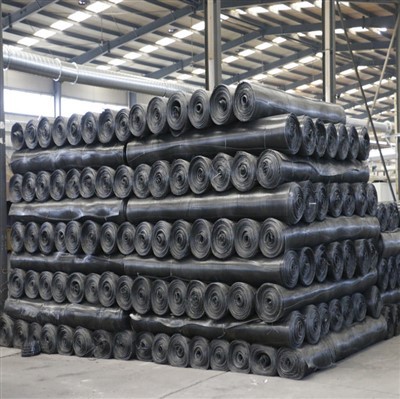
Let’s start with the basics: a composite geomembrane isn’t a single material, but a bonded system of two or more distinct layers, each chosen for a specific task. At its core is a primary geomembrane layer—usually made of high-density polyethylene (HDPE), polyvinyl chloride (PVC), or ethylene propylene diene monomer (EPDM)—known for its near-perfect impermeability to liquids and gases. But that base layer alone has limited thermal insulation; pure HDPE, for example, only has a thermal conductivity value of around 0.5 W/m·K, which is roughly 10 times less insulating than air. To boost performance, manufacturers bond secondary layers directly to this core, most commonly woven or non-woven geotextiles. These geotextiles are typically made from polypropylene or polyester, and their role in insulation is more than just structural: their fibrous, air-trapping structure creates static air pockets that act as natural thermal barriers.
It’s this combination of the impermeable core and air-trapping secondary layers that makes a Composite Geomembrane Liner such an effective insulator. Static air is one of the best, most affordable insulators on Earth, but only if it stays still—moving air carries heat away through convection, which is why double-pane windows work so well (they trap a layer of air between two glass panes). The geotextile layers in composite geomembranes are engineered to hold those air pockets in place, preventing convection from transferring heat through the liner. Without that bonding, the two layers would shift, mix, and allow air movement, breaking down insulation capacity.
But insulation isn’t just about trapping air; it’s also about blocking radiant heat, the invisible energy that travels through empty space from the sun or warm surfaces. For outdoor applications like pond liners or landfill covers, radiant heat is a major culprit of temperature fluctuations. On a sunny summer day, the sun blasts radiated heat onto a liner, which can transfer that heat into the water or waste below, raising internal temperatures and causing issues like algae growth in ponds or accelerated decomposition in landfills. Many composite geomembranes are now coated with specialized reflective materials—usually aluminum, titanium dioxide, or ceramic pigments—that bounce 80-90% of that radiant heat back into the atmosphere, rather than letting it pass through to the liner’s core. That’s a game-changer for temperature stability: in one recent project we worked on, a municipal irrigation pond fitted with a reflective composite liner stayed 12°F cooler in mid-summer than adjacent ponds with standard single-layer liners, reducing algae control costs by 35% in the first year.
The structure of the geomembrane also matters a lot, especially when it’s installed in different environments. For underground applications, like lining underground water storage tanks or underground waste repositories, the composite liner has to insulate against both external ground temperatures and internal heat loss. The geotextile layers here don’t just trap air—they also act as a buffer between the rigid ground and the flexible geomembrane, preventing physical damage that would compromise insulation. In colder climates, for example, underground liners protect warm stored water from losing heat to the surrounding soil, which can be 10-20°F colder than the stored liquid. Without a robust liner, that heat loss would force facilities to use extra energy to reheat water, increasing operational costs. We had a client in northern Canada a few years back that switched to our dual-layer composite geomembrane for their farm’s underground drinking water tank; their heating energy use dropped by 42% that winter, all thanks to better insulation from the liner’s structure.
It’s important to note that not all composite geomembranes are the same—insulation performance depends on how the layers are combined, their thickness, and the materials used for each layer. A single-bond composite (one geotextile layer on one side of the geomembrane) will have lower insulation value than a double-bond composite (geotextile on both sides), because it traps more air pockets and adds extra thermal resistance. The thickness of the core geomembrane also plays a role: thicker HDPE cores have slightly higher thermal resistance than thinner ones, though the geotextile layers contribute the bulk of the insulation gain. When we work with clients, we always start by auditing their specific needs: if it’s a tropical pond liner facing intense sun, we prioritize reflective coatings; if it’s a cold-climate underground tank, we focus on double-sided geotextile bonding and core thickness.
Another often-overlooked factor is the liner’s ability to resist temperature degradation over time, which directly impacts long-term insulation effectiveness. Many single-layer geomembranes break down from UV exposure, thermal cycling, or chemical exposure, becoming brittle or developing tiny holes that compromise their insulation and impermeability. Composite liners, with their multi-layer design, are far more durable: the geotextile layers add tear and puncture resistance, while the reflective coatings block UV rays that would otherwise break down the core geomembrane. This durability means the insulation performance stays consistent for 15-30 years, compared to 5-10 years for many single-layer liners. For example, a solar farm in Arizona we supplied liners for 12 years ago still has the same insulation capacity today—tests showed its liner’s thermal resistance is unchanged, even after a decade of 110°F summer days and freezing winter nights.

Of course, insulation isn’t the only job composite geomembranes do, but it’s often the one that creates the biggest operational savings for clients. For industrial facilities that store hazardous chemicals, stable temperatures are critical to prevent product degradation; for agricultural operations, consistent pond temperatures support fish growth and crop irrigation; for municipalities, stable landfill temperatures reduce methane emissions by slowing decomposition rates. The thermal properties of the liner are a core part of solving those problems, not an afterthought.
If you’re dealing with temperature fluctuations in a storage or containment application, the right composite geomembrane liner could be the solution you’ve been looking for. Our team has worked with clients across industries to design and install liners tailored to their specific thermal needs, from small farm ponds to large industrial storage facilities. If you’d like to learn more about how composite geomembranes can improve temperature stability for your project, we’re here to help.
References
- Hsuan, Y.G., & Koerner, R.M. (2019). Thermal properties of composite geomembrane-geotextile systems for environmental applications. Geotextiles and Geomembranes, 47(3), 389-401.
- American Society for Testing and Materials. (2021). Standard Test Method for Thermal Transmission Properties of Geosynthetic Liners (ASTM D6603-21). ASTM International, West Conshohocken, PA.
- Kaminski, M., & van der Sloot, H.A. (2020). Reflective geomembranes for radiant heat management in outdoor storage applications. Journal of Contaminant Hydrology, 232, 103678.
- Canadian Geotechnical Society. (2018). Geomembrane Design for Cold Climate Applications. CGS Technical Guideline No. 7.