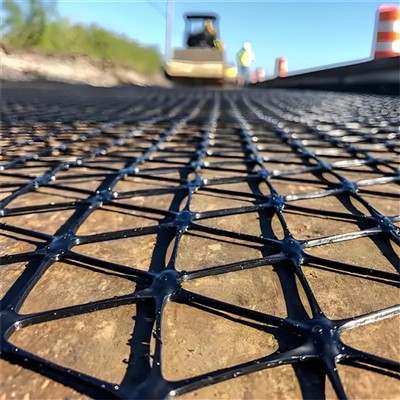

Soil settlement is a common and often troublesome issue in civil engineering projects. It can lead to various problems such as uneven ground surfaces, damage to structures, and instability in infrastructure. As a leading uniaxial geogrid supplier, I am excited to share with you how uniaxial geogrids play a crucial role in preventing soil settlement.
Understanding Soil Settlement
Before delving into how uniaxial geogrids prevent soil settlement, it's essential to understand the causes of soil settlement. Soil settlement primarily occurs due to the consolidation of soil particles under the influence of external loads. When a load is applied to the soil surface, such as the construction of a building, road, or embankment, the soil voids gradually compress. Over time, this compression leads to a reduction in the soil volume, resulting in settlement.
There are also other factors contributing to soil settlement. Organic soils, for example, are highly compressible because they contain a significant amount of organic matter. These soils can experience excessive settlement as the organic material decomposes. Additionally, changes in water content can cause soil swelling and shrinkage, leading to settlement. When the soil becomes saturated, it loses its shear strength and can settle under load.
Working Mechanisms of Uniaxial Geogrids
Uniaxial geogrids are engineered polymer materials with a series of parallel ribs and cross - members. They are designed to provide high tensile strength in one direction, which makes them particularly effective in preventing soil settlement. There are different types of uniaxial geogrids available, such as Polyester Uniaxial Geogrid, Hdpe Uniaxial Geogrid, UX Rigid Uniaxial Geogrid, HDPE Unaixial Geogrid, and UX Uniaxial Geogrid.
One of the key mechanisms by which uniaxial geogrids prevent soil settlement is through reinforcement. When placed within the soil mass, the geogrid acts as a reinforcement layer. The high - strength ribs of the geogrid absorb and distribute the applied loads over a larger area. Instead of the load being concentrated on a small portion of the soil, it is spread out, reducing the stress on the underlying soil. This distribution of stress helps to minimize the compression of soil particles and thus reduces settlement.
Another important mechanism is interlocking. The open - grid structure of uniaxial geogrids allows the soil to interlock with the geogrid. As the soil fills the voids within the geogrid, it creates a composite system. This interlocking effect restricts the lateral movement of soil particles. When the soil tries to move horizontally due to shear forces, the geogrid resists this movement, providing additional stability to the soil mass. By preventing lateral soil movement, the geogrid helps to maintain the integrity of the soil structure and reduces the potential for settlement.
Applications of Uniaxial Geogrids in Preventing Soil Settlement
Uniaxial geogrids have a wide range of applications in civil engineering projects where soil settlement prevention is crucial.
Road Construction
In road construction, uniaxial geogrids are often used in the sub - base layer. The geogrid reinforces the sub - base, which in turn supports the road surface. By distributing the traffic loads over a larger area, the geogrid reduces the stress on the underlying soil. This helps to prevent the formation of ruts and potholes caused by soil settlement. Additionally, the interlocking effect of the geogrid with the sub - base material improves the overall stability of the road structure, ensuring a longer service life for the road.
Embankment Construction
When building embankments, uniaxial geogrids are placed within the soil layers to enhance the stability of the embankment. The geogrid reinforcement helps to distribute the weight of the embankment over the foundation soil. This reduces the likelihood of excessive settlement, especially on soft soil foundations. The interlocking mechanism also prevents the sliding of soil layers within the embankment, providing additional support and preventing slope failures.
Building Foundations
In building construction, uniaxial geogrids can be used in the foundation soil to improve its bearing capacity. By reinforcing the soil beneath the foundation, the geogrid can distribute the building loads more evenly, reducing the settlement of the building. This is particularly important in areas with poor soil conditions, where the use of geogrids can provide a cost - effective solution compared to more traditional foundation improvement methods.
Advantages of Using Uniaxial Geogrids for Soil Settlement Prevention
There are several advantages to using uniaxial geogrids for preventing soil settlement.
Firstly, uniaxial geogrids are cost - effective. Compared to other soil improvement methods such as deep foundation systems, the installation of uniaxial geogrids is relatively simple and inexpensive. They can be easily transported to the construction site and installed with basic equipment.
Secondly, uniaxial geogrids are durable. Made from high - quality polymers, they are resistant to environmental factors such as corrosion, UV radiation, and chemical degradation. This ensures that the geogrid remains effective in preventing soil settlement over a long period.
Thirdly, uniaxial geogrids are environmentally friendly. They reduce the need for large amounts of traditional construction materials, such as gravel and concrete. By using geogrids, we can minimize the environmental impact associated with quarrying and transportation of these materials.
Selecting the Right Uniaxial Geogrid
As a uniaxial geogrid supplier, I understand that selecting the right geogrid is crucial for effective soil settlement prevention. Different projects have different requirements, and the choice of geogrid depends on factors such as the type of soil, the magnitude of the load, and the expected service life of the project.


For projects with high - load requirements, such as major highways or large - scale embankments, a high - strength geogrid like the HDPE Unaixial Geogrid may be more suitable. On the other hand, for smaller projects or projects with less demanding load conditions, a more cost - effective option like the Polyester Uniaxial Geogrid could be considered.
Conclusion
In conclusion, uniaxial geogrids are an effective solution for preventing soil settlement in various civil engineering projects. Through their reinforcement and interlocking mechanisms, they distribute loads, restrict lateral soil movement, and improve the overall stability of the soil mass. With their cost - effectiveness, durability, and environmental friendliness, uniaxial geogrids have become an increasingly popular choice in the construction industry.
If you are involved in a project where soil settlement prevention is a concern, I encourage you to consider using our high - quality uniaxial geogrids. We have a wide range of products to meet your specific needs, and our team of experts is ready to provide you with professional advice and support. Contact us today to discuss your project requirements and explore how our uniaxial geogrids can help you achieve a successful and stable construction.
References
- Koerner, R. M. (2012). Designing with Geosynthetics. Pearson Prentice Hall.
- Bonaparte, R., & Christopher, B. R. (1993). Geosynthetics in Civil Engineering. ASCE Press.